Where there’s a will, there’s usually an argument

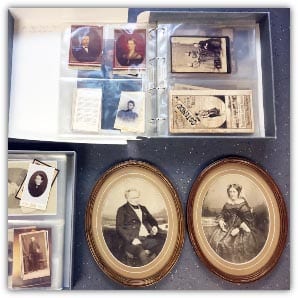
Reading Branch meeting 29th September 2022 Speaker: Sue Ellis Sue took us on a liberally illustrated look at wills, what they look like, what terminology they include and what information they can give a family historian. Wills were first recorded by the ancient Greeks mainly to explain how to dispose of a person's estate of there were no male heirs. Roman wrote wills too. 272-337AD saw the start of the church's involvement in wills. From the Middle Ages, there are two wills still in existence, those of King Alfred and his nephew. During this time wills were proved exclusively by ecclesiasts. Wills have been used to estimate that 60% of the country's population of 60,000 died in the black death. Wills cover land (real estate) which id 'devised' to beneficiaries, and personal estate (belongings, jewellery, clothes, furniture, etc.) which is 'bequeathed'. Prior to 1837, wills that included real estate only covered land that belonged to the testator up to the date of the…
Comments Off on Where there’s a will, there’s usually an argument

Canal People – Joint meeting with Bracknell & Wokingham

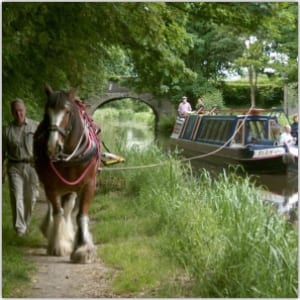
Joint meeting 20th November 2020   Speaker: Martin Buckland   A canal is defined as an artificial waterway which may join up rivers whilst rivers are natural waterways. Canals have locks and need to be able to climb hills such as The Cotswold Canal for example which climbs 106.68 metres. Canals were good at moving fragile goods such as pottery. A horse carrying about 2 cwt was slow and could break the product compared to a barge with a horse pulling 20 cwts in safety. Irrigation was the origin of the canals. Between about 520 and 510 BC the Persian Emperor, Darius I built a canal linking the Nile and the Red Sea and the Grand Canal in Venice built between 3rd Century BC and 13century AD is used for irrigation and transport. The Pont du Gard the ancient and highest Roman aqueduct bridge  built in the first century AD to carry water over 50 km used only basic surveying equipment. Britain’s canals were started by the…

Comments Off on Canal People – Joint meeting with Bracknell & Wokingham

Photographs and memorabilia

Reading Branch meeting 29th October 2020, conducted on Zoom Speaker: Members - Peter Caton, Richard Brown, Richard Croker and Graham Vockins Peter Caton chose a 200 year old jug which had been handed down through the family from an Aunt Emily. He had researched documents which involved not one but three marriages by one ancestor. He again reestablished links to the entertainer Wattie Hildyard of whom Peter had previously spoken.  Richard Brown told members of his Grandmother's WW1 Medal. Emily Brown was born in the Parish where Charles Kingsley was a Minister in 1869. Through various links with Thorneycroft engineering. the London General Omnibus company and the College Arms pub in Pamber End. Emily joined the V.A.D. as a Nurse in 1915 and  clocked up 3457 hours of unpaid voluntary service. Richard Croker spoke of Lorne Campbell Reid, the Stepfather of his mother and his piece of memorabilia was a small wooden box engraved JC to Lorne Reid. Via the internet he managed…

Comments Off on Photographs and memorabilia

Some Wallingford Crooks

Reading Branch meeting 24th September 2020, conducted via Zoom Speaker: Margaret Crook Margaret explained that her research into her husband’s family tree started before the internet and the computers had become the tool of choice it is today. From a family bible handed down by her father-in-law dated 1896 it gave her a start into the Crook dynasty. Margaret’s started collecting names of Crooks from the Berkshire Record Office, at that time in Shire Hall, checking parish records of churches in Wallingford, Cholsey, Britwell Salome etc. She adopted the method of collecting all names and references to relationships in the records to build seven Crook families and from there make the connections between them using probate and wills. She purchased the 1881 census on 25 C.D’s in 1998. Margaret had developed flesh on the bones by using newspaper archives particularly the Abingdon Herald. With the coming of the internet she made contact with an Australian historian who had a relative who had been…

Comments Off on Some Wallingford Crooks

The Colin Spickett Experiment

Reading Branch meeting 25th June 2020, conducted on Zoom Speaker: Mark Bowman This presentation was a display of how much can be achieved for free in a short space of time. Mark showed that starting only with a name (albeit an unusual one) and a rough date of birth, you can, using free, online resources, construct a pedigree going back 250 years, all in a few hours. As usual, Mark’s talk was engaging and generated quite a discussion afterwards.

Comments Off on The Colin Spickett Experiment

Jane Austen and the Thames Valley Connection

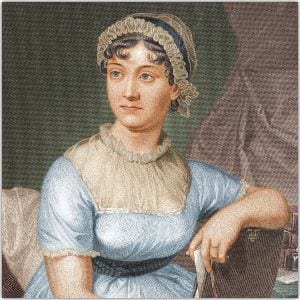
Reading Branch meeting 28th May 2020, conducted on Zoom Speaker: Joy Pibworth Joy outlined the family background of Jane’s life and the places where those people lived. She painted a picture of her parent’s lives and those of her close relatives. They involved places as far away as America, Russia as well as Oxford, Tonbridge and Bristol in the U.K. There were stories of Fishing Fleet (female passage to India to seek marriage) and the scandal of trials for stealing lace which resulted in acquittal.  One of her ancestors, Sir Thomas White, who was born in Reading in 1492 was a clothier and educated at Reading School, he served an apprenticeship to a wool merchant and went on to found St John ’s Baptists College. Jane’s father George was raised by his uncle Francis, and her mother Cassandra (nee Leigh) was the daughter of a Rector. They were married in 1764 in Bath and raised eight children including Jane who was the second…

Comments Off on Jane Austen and the Thames Valley Connection

A Caribbean Journey: experiences of researching Barbadian ancestors from the UK

Reading Branch meeting 27th February 2020  Speaker: Guy Grannum  Guy gave an interesting talk on how he came to research his Barbadian roots and the types of documents that can aid with Barbadian ancestry. Guys started researching for his parents 25th wedding anniversary, and discovered an international family covering South Africa, Gibraltar and Majorca. Unfortunately, early civil registration records gave no clue to the origins of the family name, as there were only a handful of entries. Most entries date from 1955 onwards. Through his work at The National Archive (previously the Public Record Office), Guy discovered his grandfather and great-uncles listed in Colonial Office Lists, stating that they were all born in Barbados. As Barbados was a British colony, and now an independent state within the Commonwealth, many of their records have a British base. The hardest thing is to work out where the records are held and what the access is to them. Some are available through subscriptions sites as well…

Comments Off on A Caribbean Journey: experiences of researching Barbadian ancestors from the UK

Victorian Divorce

Reading Branch meeting 30th January 2020 Speaker: Simon Burbidge Simon spoke of his research into his ancestors who had been divorced by the time of the 1901 census. Prior to 1858 Divorce was subject to Ecclesiastical Law with basically consummated or unconsummated marriage. It required an Act of Parliament and grounds were usually separation, civil suit or adultery. Only 2 divorces a year were recorded in 1670, 322 between 1670 and 1838 and in 1900 there were 560 with only three women suing for divorce. Notable cases from past were 1804 De Manville which involved custody of a child, it was ruled that a child belonged to father unless in danger of being harmed. Other cases included Lord Melbourne the Prime Minister and Caroline granddaughter of Richard Sheridan. Palmerstone re launched a Bill in 1855 which became Law in 1858. In 1920 Legal aid became available for Divorce. Details are available online in Ancestry TNA index J77 / 78. This was a very…

Comments Off on Victorian Divorce

Short talks and quiz

Reading Branch meeting 12th December 2019 Speaker: Members There were two short talks by members, a Berkshire dialect quiz from Vicki and the traditional non-alcoholic mulled wine and mince pie courtesy of Rosemary and Angie. Angie Catt spoke about her great-grandfather John Gibbons (West) born in Bath who enlisted in the 12th Prince of Wales Lancers in 1849 in Reading. At his attestation he was stated as being eighteen and a half, and five feet nine inches tall. He was involved in the 8th Kafir War which was the longest military action in Africa lasting 100 years. It was actually nine wars in the Eastern Cape where Smith was disgraced and dismissed. He survived the sinking of HMS Birkenhead where the first use of the command “Women and Children first” was issued in 1852. His military career took him from battles with the Xhosa in Africa; Crimea 1845, Sevastopol 1855 and his last campaign was in the Indian Mutiny 1857. Retiring after 12…

Comments Off on Short talks and quiz

Birth and Death Certificates

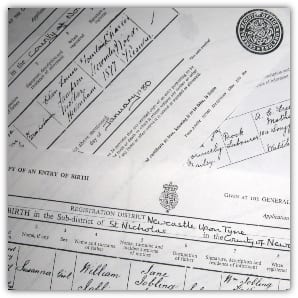
Reading Branch meeting 28th November 2019 Speaker: Antony Marr Speaking from a background of an ex Deputy Registrar he gave an interesting insight of what can be found on these certificates. The rules surrounding these certificates are covered by a 150-page instruction book. Original certificates will have original signatures; the GRO (General Register Office) version is a copy of a copy. Four checks are done on birth certificates (not telling the truth is purjury) 1. Live birth computer check with hospital/midwife (no still births) 2. Correct district 3. Within time limit (Registrar 12 months, parents 42 Days) 4. Not already registered. Informants a) Who signed? b) their qualification c) Address of the informant. Who can sign, i) Mother, ii) Father, if married (not unmarried fathers), iii) Occupiers of the premises where birth occurred, iv) Anyone present at birth, v) Person in charge of child. Childs surname is specified since 1969 and from 1950 put in capital letters. Today any surname is possible not…

Comments Off on Birth and Death Certificates

Policing Reading in WW1

Reading Branch meeting 31st October 2019 Speaker: Tony Keep from Thames Valley Police Museum  Tony started his research to commemorate what was thought to be 47 policemen lost in WW1, but actually turned out to be 49. At the time of WW1 eight forces existed covering the area now known as Thames Valley force. In his research he used Examination Registers which were kept manually, records from Berkshire and Buckinghamshire Records Offices, Chief Constables Reports, Standing Joint Committee Reports, Watch Committee minutes and books or newspaper reports. Additional material was gathered from the Thames Valley Museum, The National Archives and the Internet. The first Police Force was the Metropolitan founded in 1829 and following Acts of Parliament in 1835 and 1839 became a paid force. In 1856 National Government legislation saw a change in how the force was organised. County Police Forces controlled by Standing Joint Committees under a Chief Constable and Borough Police Forces under Watch Committees with Head Constables. In 1914…

Comments Off on Policing Reading in WW1

Putting Berkshire on the Map (Gough to Google)

Reading Branch meeting 26th Sept 2019 Speaker: John Leighfield John opened his talk with an anecdote about Einstein and his chauffeur which set the pace and delivery for the evening. He informed the gathering that the earliest maps were around 6000 BC from Turkey, then from 1400 BC Italian wall carving and then 6th century BC from a tablet found in Babylon. Important dates from Britain were 150AD Ptolemy, (1480 print shown) and Matthew Paris 1250. Richard Gough was a notable collector and writer who left a c1360 map to the Bodleian Library which he had purchased in 1774 for half a crown. The big changes came in the 16th century which were brought about by the revolutionary things of printing, military threat (Spanish), the development of surveying as a profession (Henry VIII and Elizabeth I). Christopher Saxton from Leeds in Yorkshire deserves greater recognition. In 1570 he was granted a monopoly by the Elizabethan Court for 10 years on map production. By 1574…

Comments Off on Putting Berkshire on the Map (Gough to Google)

- End -

No more pages to load