
Table of Contents
How BerksFHS Can Help
Our Family Research Centre at L14 London Road Campus, London Road, Reading RG1 5AQ gives you free access to the core resources for UK census research and also many overseas census, including those for the USA.
- Findmypast – the full UK census series 1841-1921, and the 1939 Register
- Ancestry (worldwide edition) – the full census series 1841-1921, and the 1939 Register
- The Genealogist – census records with georeferenced historic map overlays; useful when other platforms’ transcriptions fail
- FamilySearch – we are a FamilySearch Affiliate Library, giving visitors access to additional digitised records not freely available online at home
- Our bookshop, available to purchase online and face-to-face in the Family Research Centre, contains Berkshire-specific census material, not available online elsewhere. These include, Binfield’s 1801 census https://berksfhs.org/product/binfield-1801-census/, a transcript of Toomer’s 1815 census of Newbury https://berksfhs.org/product/newbury1815-census-of-newbury-by-joseph-toomer-cd-bfhs/, East Hendred’s census of 1821 and 1831 https://berksfhs.org/product/the-parish-of-east-hendred-1821-and-1831-censuses/, and Berkshire’s religious census of 1851 https://berksfhs.org/product/berkshire-religious-census-1851berkshire-record-society-volume-14/.
- In addition, our reference library contains a transcript of Sonning’s 1821 census, one of a small number of Sonnings censuses which survive, the originals of which are in the Royal Berkshire Archives, and a copy of Edward Higgs “A clearer sense of the census : the Victorian censuses and historical research”.
Our experienced Research Assistants are on hand to help. Check berksfhs.org for current opening hours.
The Census Series 1841-1921
An official census of England and Wales has been taken every ten years since 1801. The censuses of 1801, 1811, 1821 and 1831 when collated centrally retained statistical information only. They do not name individuals and have limited genealogical value (though some original enumerators’ notes survive locally – ie the 1801 census for Binfield and the 1821 and 1831 censuses for East Hendred). From 1841, every person present on census night is recorded by name.
Access: All censuses 1841-1921 are available on Ancestry and Findmypast, free at the Family Research Centre. FamilySearch holds free indexes for most years.
The 100-Year Rule and Commercial Exclusivity
Census records in England and Wales are closed to the public for 100 years from the date they were taken, in accordance with a longstanding policy reflecting the undertaking of confidentiality given to householders at the time of each census.
When a census is released, The National Archives typically awards a commercial digitisation contract to a genealogy platform, which receives an exclusivity period – usually around three years – during which it is the only commercial platform to carry the records. This arrangement funds the digitisation work. After exclusivity ends, the records become available on other platforms. The 1921 census was released exclusively on Findmypast in January 2022. Its three-year exclusivity period ended and the records became available on Ancestry in January 2025. The next UK census release is the 1931 census for Scotland, due in 2032, sadly, the next English and Welsh census releases aren’t due until 2052.
Year by Year Guide
1841 – HO 107 The first official census to name individuals. Records name, approximate age (rounded down to the nearest five for adults over 15), occupation, and whether born in the same county. Does not give relationship to head of household. Taken on 6 June 1841.
1851 – HO 107 First census to record full relationship to head of household, exact age, marital status and parish and county of birth. A substantial improvement on 1841 for genealogical purposes. Taken on 30 March 1851. There is also a column to record whether ‘Blind, Deaf or Dumb’, but some census enumerators have later added check marks e.g. ticks on the right of the form, making this data unclear.
1861 – RG 9 Same format as 1851. Taken on 7 April 1861.
1871 – RG 10 Same format, with the right hand column now including ‘Imbecile or Idiot’ and ‘Lunatic’. Taken on 2 April 1871.
1881 – RG 11 Same format as 1871. The 1881 census has the most comprehensive free index of any census year, produced by a major volunteer project. Taken on 3 April 1881.
1891 – RG 12 Same format with the addition of extra data a) number of rooms in house, if less than 5 and b) Whether an Employer, Employed or Neither. Taken on 5 April 1891.
1901 – RG 13 Same format but with a variation on employment options : ‘Employer, Worker or Own Account’ or ‘Working at Home’. Taken on 31 March 1901.
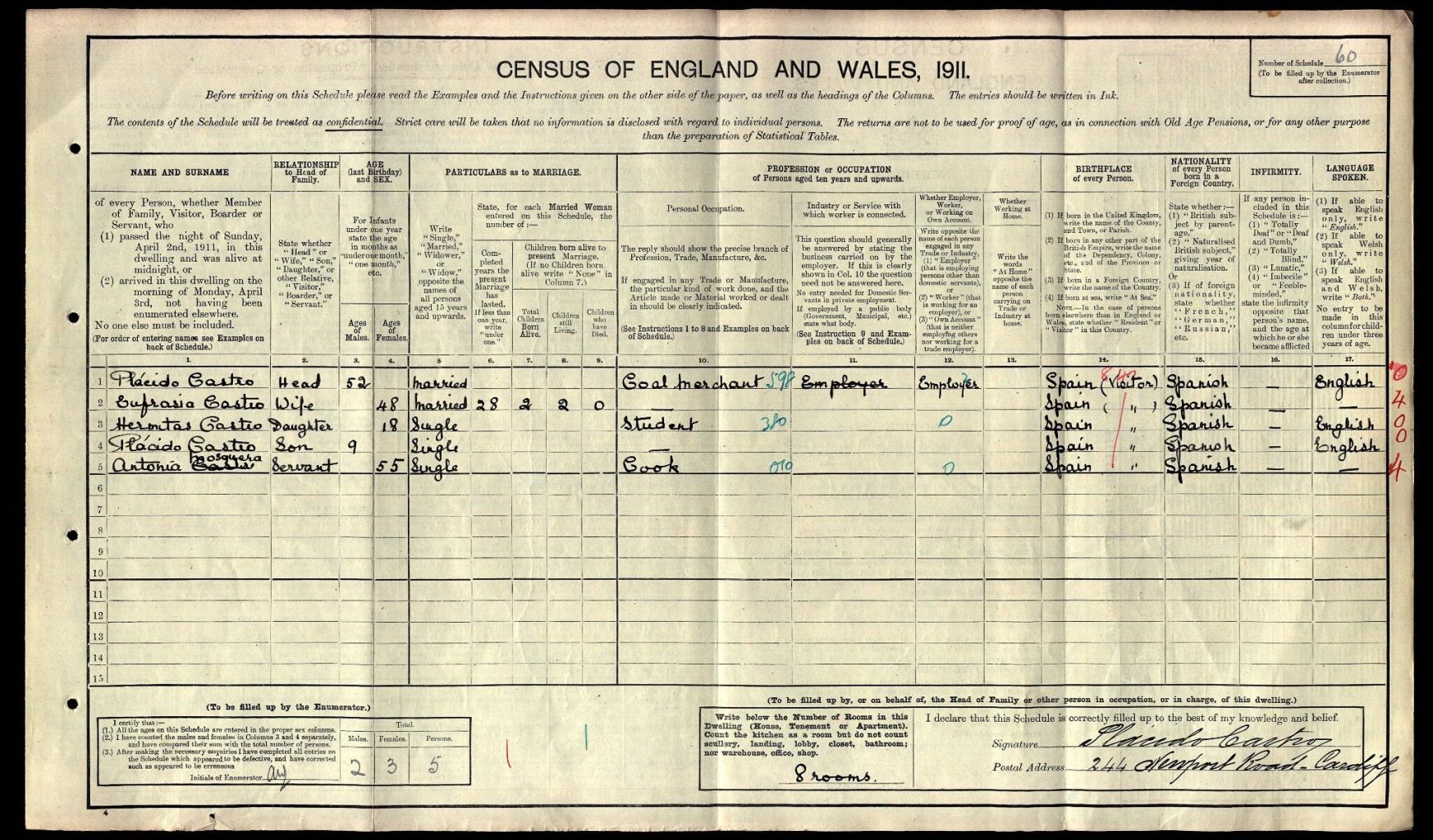
1911 – RG 14 A significant change from earlier censuses. Householders completed their own schedules rather than having an enumerator copy the information into a book. The 1911 census therefore often shows the householder’s own handwriting and can include additional notes. It records the length of marriage, number of children born and number still living – valuable for family reconstruction. Taken on 2 April 1911.
1921 – RG 15 The most recently released and in many respects the most informative census yet available. Exact age is given in years and months. Nationality recorded, as well as Birthplace. Added questions on education status, employer, workplace and nature of work – giving a clearer picture of occupational life than any earlier census. Also records whether parents were alive or dead for children under 15. Taken on 19 June 1921. Available on both Findmypast and Ancestry with Findmypast’s transcription used by both platforms. This contains errors in some entries so if you cannot find an ancestor, try browsing the original images.
1931 – DESTROYED The 1931 census for England and Wales was destroyed by fire in 1942. No copies survive. The 1931 census for Scotland was not destroyed and will be released in 2031.
1941 – NOT TAKEN DUE TO THE WAR. The 1939 Register (see below) partially fills this gap.
1951 and later The 1951 census will be released in 2052 under the 100-year rule. All later censuses remain closed.
Searching the Census Effectively
The census was a snapshot of the population on a single night. Anyone away from home – travelling, in hospital, in prison, at sea, working away – would be recorded at their location on census night, not at their usual address. If you cannot find an ancestor in the expected place, consider where else they might have been.
Work back through time from details you know are correct, using each census to build towards earlier ones and the wider family picture.
Practical search tips:
Try Findmypast first, but make use of Ancestry and The Genealogist too – each platform has different search facilities and different transcriptions of names and places, so an ancestor missed on one may be found on another.
Search one census year at a time rather than across all years at once. Enter as few details as possible to start – name and approximate age is often enough – and avoid exact-match filters. You can always narrow results once you have something to work with.
With common surnames, try searching for an unusual first name instead. With any name, try spelling variations – many ancestors were illiterate and enumerators recorded names phonetically, sometimes with considerable creativity. Adding a known family member or servant to the search can help pinpoint the right household where a name alone returns too many results. Immigrants often anglicised their names for official purposes.
Never trust a transcription alone. Transcription errors are frequent , particularly for unusual surnames and place names. Always look at the original page image – the transcription is a finding aid, not the record.
If you still cannot find someone, consider these possibilities: parts of some census years have been damaged or lost; people were sometimes recorded in two places on the same night; ages were routinely misreported (often to conceal illegitimacy or other family circumstances); first name diminutives and abbreviations were common; in towns, few streets were numbered before the late 19th century and many have since been renumbered; and some people were simply missed.
Was your ancestor abroad, serving in the Army or Royal Navy, at school, in domestic service, in hospital, in prison or in the workhouse? All of these situations placed people away from their usual household on census night. For those on board a commercial vessel, there may be a census return for their ship, if it was in port at the time of the census. Canal workers, navvies etc were sometimes captured elsewhere e.g. lodging at the nearest public house.
The enumeration district is the geographical unit used to organise each census. Street indexes for the major cities (London, Birmingham, Manchester and others) are available on Ancestry and Findmypast to help locate the correct district before searching by name. Wildcard searches are available on both platforms. The definitive source for information about what each census collected is The National Archives research guide at https://www.nationalarchives.gov.uk/help-with-your-research/research-guides/census-returns/ – the data gathered changed with every decade and the guide explains the differences clearly.
The 1939 Register
Access: Findmypast and Ancestry – free at the Family Research Centre
The 1939 Register is not a census but functions as one for genealogical purposes. Compiled on 29 September 1939 – National Registration Day – it recorded details of over 41 million civilian members of the population of England and Wales. It was created as a wartime measure to enumerate the civilian population and to issue identity cards. Scotland and Northern Ireland were included in the survey but their records are not publicly accessible at present.
The register records name, address, sex, marital status, date of birth (day, month and year – more precise than most other records of the period) and occupation for virtually every civilian resident in England and Wales.
The register became multifunctional over the following years: identity cards were issued from 1939, ration books from 1940, and from 1948 it formed the basis of the NHS patient register. This extended lifespan means the register was updated over time – annotations include single women’s later married names and notes of specific wartime involvement, making it more informative than a straightforward snapshot. It is particularly valuable because it fills the gap left by the destruction of the 1931 census and the absence of a 1941 census.
Some entries remain closed because the individual was still living at the time of release. Closed entries appear as a black redacted line. They can be opened on application if the individual can be proven to have died, otherwise the 100 year rule applies.
The 1939 Register covers England and Wales only. Scotland had a separate National Register also compiled in 1939, but it is not yet available online.
Census Substitutes for the Missing Years
For the periods not covered by the census series, the following sources can partially substitute: Land Tax Assessments (1780-1832; Electoral Registers (from 1832); Rate Books and Poor Rate Assessments; Street and Trade Directories; and Hearth Tax (1662-1674).
This guide was compiled by Berkshire Family History Society. https://berksfhs.org Links verified April 2026. Access terms, opening hours and record availability change – always check the current position on each site before visiting or searching.
