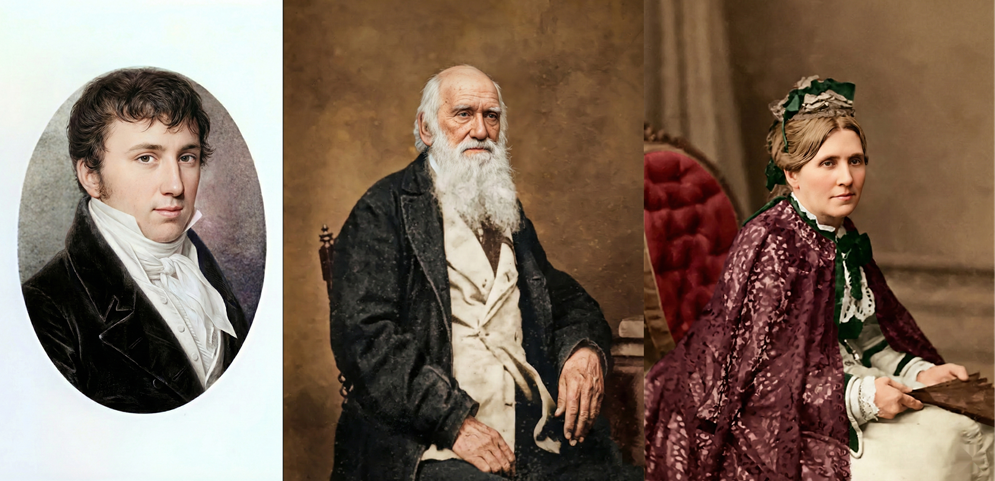
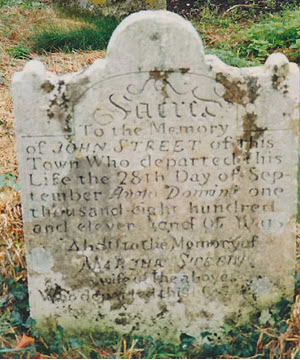
At the time of their marriage in Crediton in 1780, John had been living in Chulmleigh for at least 6 years, and for the previous 2 years, Lincolnshire-born Martha had been living in Crediton with her guardian Sir Jacob Wolff & family.
From the information we have we know that in 1804 John Street, gent, was employed as a gamekeeper for Sir Jacob Wolf, Bart, at the Manor of Chulmleigh. Over his lifetime it would appear that he managed to become quite well-to-do as can be seen by a sale of property following his death.
But where were John’s roots? There were plenty of Street families in Exeter and another set in Berkshire, the county suggested by my 2x great grandfather Charles Drew Street (known as CD), taken from letters written to his son Charles Petvin Street in 1883 about a supposedly ongoing case in the English Court of Chancery.
John & Martha had three children, Thomas (1782-1828) who married Catherine Snelling, Martha (1780-1858) who married William Cawsey, and Sarah (1785 – ?) who married Richard Reed All three children were born in Chulmleigh.
My 3x great grandparents, Thomas, a surgeon in Exeter, & his wife Catherine née Snelling had four children, Francis Gale Snelling Street (1805-1870), Elizabeth Procter Street (1806-1834), Charles Drew Street (1807-1887), and Emma Catherine Street (1810-1881). Elizabeth is buried with her mother Catherine in the churchyard of St Bartholomew in Bow, Devon. Her three siblings all emigrated to Australia,
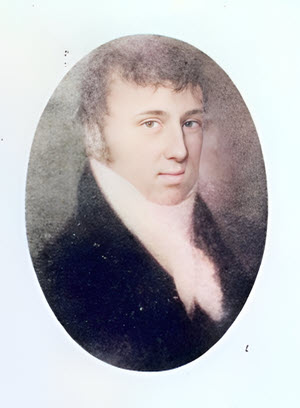
Charles in 1832, and Francis & Emma in 1838, a few days after Francis’s marriage to his first cousin, Martha Procter Street Reed.
In 1836, Charles Drew Street, Surgeon, married Susanna Foster in Sydney, New South Wales and by 1854 eight children had been born to them, Charles Petvin Street being the 4th in line and the eldest surviving son.
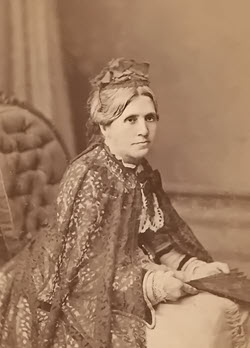
All the children were born in areas in and around Muswellbrook & Raymond Terrace in NSW but from c.1850, Charles Drew Street was both doctoring and prospecting (albeit unsuccessfully in the latter case) in Hargraves in the central western goldfields of NSW and commuting the 125 miles in between.
He was often declared insolvent and spent much of his time in a quest to reclaim properties which had been lost decades earlier in England and Ireland.
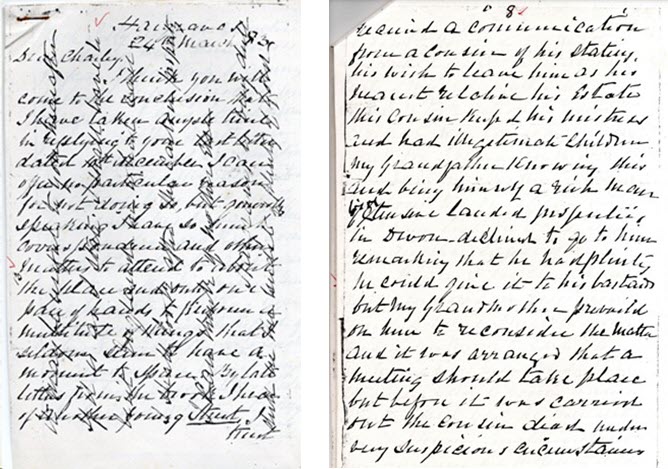
In 1883, fifty-one years after arriving in Australia, Charles Drew Street wrote a letter to his son Charles Petvin Street about a supposedly ongoing case in the English Court of Chancery. Charles Drew Street believed that he was the only eligible claimant and that the property involved should be his. He was referring to the Estate of the late William Wimpey, who died 17 August 1814 which included the Manor of Bratton Clovelly.
The letter (shown below) contained a number of clues as to the identity of John’s parents, some of which have now been shown to be correct. Here’s a précis of that letter:
In the early 1800s John Street of Chulmleigh had been approached by a cousin to take over his (the cousin’s) Estate. However, as this cousin and his mistress had illegitimate children, John declined the request both on moral grounds and because he considered himself to be well enough off as the owner of a number of properties in Chulmleigh.
A meeting was arranged but never took place because “the cousin died under very suspicious circumstances – no doubt poisoned”.
As a boy of about 12 years of age, Charles Drew Street remembered the Court Case which took place in 1819 where his father Thomas & his aunts Martha & Sarah were claiming to be the next-of-kin of William Wimpey (more on this to follow). He also made mention of meeting someone in London (c.1827) who was supposedly a Trustee of the Estate, and who implied that the person who eventually inherited William Wimpey’s Estate was “not a member of the family”.
Five years later when Charles Drew Street was working as the surgeon on a whaling ship on its way to the South Seas, he reported that the Chief Officer mentioned that he had information on the Devonshire property, this being that “the party who got the Estate was illegitimate and by forging false Certificates of Birth and Perjury got the property but that he did not long enjoy his ill-gotten wealth for remorse drove him to commit suicide.”. (Nothing’s been found to date to substantiate these last two comments.)
At the conclusion of the letter Charles Drew Street stated that “the name of the estate is Bratton or Gratton and is situated in Devonshire or Berkshire, I am inclined to think in the latter county where my ancestors formerly lived, the Devon-line Streets are a branch – keep this letter for a while – life is uncertain – it may be useful to you hereafter”.
About two and a half years ago my good friend and fellow researcher Peter Selley and I joined forces to try to track down the origins of John Street, c1743-1811. Around the time of my original article, Peter had come across Dr Francis Gale Snelling Street who was one of his medical predecessors in Bow. We decided to investigate all the people whose names appeared on various archived property documents relating to the dispersal/sale of Chulmleigh Manor around 1775, and one surname that eventually bore fruit was Wimpey.
Joseph Wimpey became Lord of the Manor of Chulmleigh in 1767. His name appeared in an interesting legal case which turned up in the courts in 1819, that of Street v Bascombe, which involved a number of parties vying for the position of next- of-kin of the Intestate William Wimpey of Bratton Clovelly, the bachelor son of the aforementioned Joseph and his wife Jane Pendar. The plaintiffs in this case were my 3x great grandfather Thomas Street, and his sisters Martha Cawsey and Sarah Reed.
They claimed that as the children of John Street (deceased), their relationship was one degree closer to William Wimpey than the defendants Mary & Francis Bascombe & William Wiltshire because the father of those Streets, John Street, was the son of John & Sarah Street and that the said Sarah Street was the sister of Jane Wimpey the mother of William Wimpey the said Intestate’.
Bascombe & Wiltshire in their defence stated that they ‘do not know believe or admit it to be true that the said John Street was the son of John & Sarah Street or that the said Sarah Street was the sister of Jane Wimpey the mother of William Wimpey the said Intestate’.
Further research revealed that Jane Pendar married Joseph Wimpey in Woolhampton, Berkshire on 21 October 1734. Without taking too great a leap of faith, this suggests that John’s mother’s name was Sarah Pendar and makes John Street of Chulmleigh & William Wimpey (the Intestate) first cousins. So that information cautiously knocks at least a couple of rows of bricks off the wall which has stood steadfastly behind John Street of Chulmleigh for decades and introduces the Berkshire connection.
It was also discovered that the said William Wimpey in his seventies had fathered 4 children out of wedlock (with Joan Hexworthy) in Bratton Clovelly and this fact, while no names were mentioned, was more or less confirmed in the extract of the letter my 2x great grandfather wrote in 1883.
There are a number of inconsistencies in Charles Drew Street’s account of events. John Street of Chulmleigh died in 1811 so it may have been his death that caused the meeting to not take place.
At the time of William Wimpey’s death in 1814, Charles Drew Street was just 7 years old so he would not have had any real memory of the events, but the legal wrangling went on for several years.
However, his grandmother Martha, John Street’s wife, lived on until 1846 and because Thomas, Martha & Sarah lost the Street v Bascombe case, the recounting of the event and its disappointing result was no doubt perpetuated by his grandmother, his older brother Francis Gale Snelling Street, and his mother Catherine Street.
The reference to the cousin being ‘no doubt poisoned’ is rather fanciful but with no record of William Wimpey’s cause of death, who knows!! If anyone has any information to cast a shadow on this next scenario, we would love to hear it.
The first confirmed record of John Street’s appearance anywhere was on Lease & Release documents in 1774 in Chulmleigh when he was aged 31. It’s likely that John (b. 1743 in Berkshire) was recruited by his uncle Joseph (Wimpey) to be the caretaker of the manor of Chulmleigh after he (Joseph) acquired it in 1767.
We believe John had come from a farming family in Lambourn Woodlands in Berkshire, but, like his descendants, in their inheritance disputes, we’ve not been able to absolutely confirm his parentage.
However, a baptismal record in the parish registers of Lambourne states a John Streat was baptised on 14 August 1741, father John and mother Sarah Streat of Woodlands, which we believe is relevant.
But the critical thing is the reference to “supposed wife” in Sarah’s burial entry:
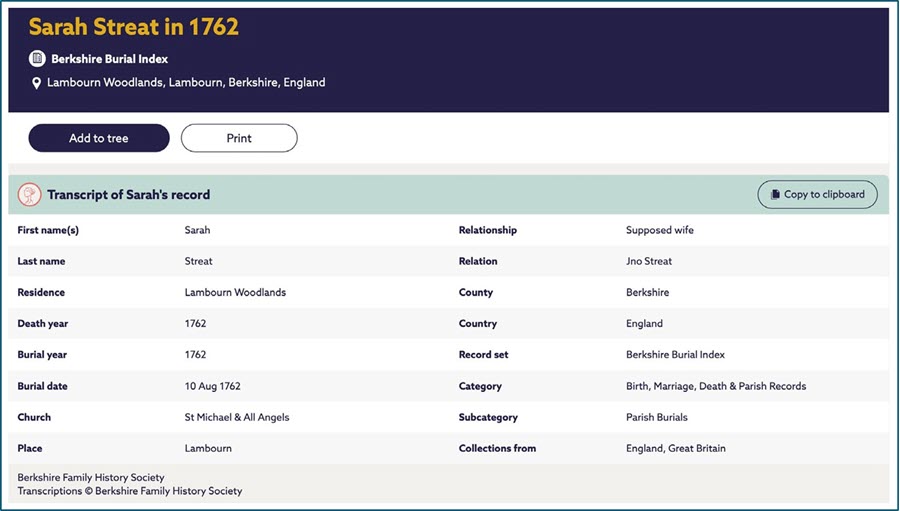
If this was the case, then John of Chulmleigh was probably illegitimate and therefore barred from inheritance unless a Will said otherwise.
As for how John came by his position at Chulmleigh Manor, perhaps Joseph Wimpey didn’t trust Devonian agricultural labourers and wanted an outsider to run the estate, and no doubt he (Joseph) would have been keen to put into practice all the farming methods he’d written about in books over the years.
Joseph was born in Newbury c.1710 and at the age of 24 he was recorded as being a basket-maker there, his apprentice at the time being a John King. Joseph became established as a haberdasher in London before becoming the banker to William Earle and William Davenport who were both involved in the slave trade based in Liverpool. Joseph Wimpey sourced the glass beads that were exchanged for slaves in West Africa before going bankrupt in 1772.
Next, in a mysterious twist, an Elizabeth Street Martin appears in Chulmleigh.
Born out of wedlock in Wantage, Berkshire on 27 January 1772, she was the daughter of Sarah Martin. The Poor Law Settlement records held by the Southwest Heritage Trust state:
Now living in Chulmleigh, she was born in Wantage, Berkshire and lived there until she was 15 when she went to Oxford, All Saints where she lived with John Fry for 2 years as a covenant servant, then went to St Alls and served Charles Stewart for less than a year, returned to Wantage with John Stephens as a covenant servant for 3 months, since she has been a sojorner in Chulmleigh, at Christmas she returned to Wantage with Mr Perkins, victualer and had a female bastard which is now with her in Chulmleigh.
The most likely explanation is that our John Street, then in Chulmleigh, was the father of this child. Lambourn Woodlands, Berkshire is just a mere 11 miles away from Wantage where Sarah Martin was born. Were John & Sarah taken together to Chulmleigh Manor to work for John’s uncle, Joseph Wimpey? Or did they go there separately and form a relationship once they were there?
Another unlikely but imagined scenario by the author of this article (which is not backed up by my co-researcher!) is: Could it have been that Elizabeth Street Martin was either William or Joseph Wimpey’s daughter and not wanting to have their names besmirched they paid for her upkeep through John who took her under his wing?
And just maybe they paid John as well? In return for his kindness, Sarah named her daughter Elizabeth Street Martin after John?
Whoever the father was, the fact remains that Sarah Martin lived in Chulmleigh until she died there unmarried in 1812, just 3 months after John Street passed away. Her daughter, Elizabeth Street Martin married twice, firstly to John Fewings and after his death to Thomas Lewis. She also remained in Chulmleigh until her death in 1839.
This is what we now believe:
- Joseph Wimpey of Newbury, Berkshire was John Street’s uncle by marriage.
- John’s mother was Sarah Pendar, Joseph Wimpey’s sister-in-law.
- It is probable that John Street’s parents were not married. This may have destroyed the claim to the Wimpey inheritance.
- Joseph Wimpey owned Chulmleigh Manor from 1767 until 1772 when he was declared bankrupt.
- The Administrators of Joseph’s Estate most likely sold the Manor to Sir Jacob Wolff c.1780.
- John Street was employed as the gamekeeper of Chulmleigh Manor by Sir Jacob.
- Sir Jacob Wolff was Martha Procter’s guardian at the time of her marriage to John Street in Crediton.
- William Wimpey’s Estate, which included the Manor at Bratton Clovelly, eventually became the property of the heirs of the late Joseph King of Newbury in Berkshire who was William’s second cousin. Joseph died just three months after adding a codicil modifying his Will to take into account the Bratton Clovelly inheritance which he was not expecting. The inference in Charles Street’s letter was that Joseph King inherited the Estate of William Wimpey under false pretences & that he subsequently committed suicide. This has yet to be or may never be proved.
- Thomas, Martha & Sarah Street were William Wimpey’s 1st cousins, once removed. Joseph King was his 2nd cousin.
- William Wimpey was the next of kin and administrator of the Estate of his uncle William Pendar, the brother of Jane & Sarah Pendar. William died intestate and a bachelor at Woolhampton, Berkshire in 1799.
- Joseph Wimpey, William Wimpey, Sir Jacob Wolff and others were all at various times bankers for John Street when he was Leasing & Releasing and/or buying properties in Chulmleigh.
- Mary Bascombe née King was one of the Defendants in the Street v Bascombe court case of 1819. William Wiltshire, the other Defendant was allegedly the son of another sister of Joseph Wimpey the Elder.
Much of the research groundwork on John Street was done 50-odd years ago by one of his 2x great grandsons, Carrington Reuel Street & his wife Gwen who over a number of visits to England from Australia, sat in as many record offices as possible and laboriously copied word for word every available document containing the surname of Street. They were obsessed with solving the mystery of John Street’s parentage, and the walls of the basement of their home were covered with various charts & scrolls and just about everything in the room was related to finding out about John Street’s life prior to 1774. Reuel died in 2002 & Gwen 18 years later, not knowing anything of the above update.
Perhaps they’ve now connected with John and know everything there is to know.
It’s been a lot of fun and hard work creating this update but it just goes to highlight the online advantages we now have which have enabled Peter & myself to do this with 10,000 miles between us!
If any readers of the Berkshire Family Historian can throw light on the ancestry of John Street, I’d love to hear from you. [Ed: the Forum is the perfect place to do this.]
Editor’s note:
Stories from the Victorian period are often accompanied by contemporary portraits and early photography and Jenny Grant’s article is no exception. We’ve reproduced the images in the original form but the advent of AI tools allows us to easily carry out enhancements to colourise and remove noise and dust. This has to be done sympathetically and with restraint to retain authenticity. Below, is a panel of the two images used above, along with a later image of CD Street. Jenny has given permission for us to include these: