
Table of Contents
How BerksFHS Can Help
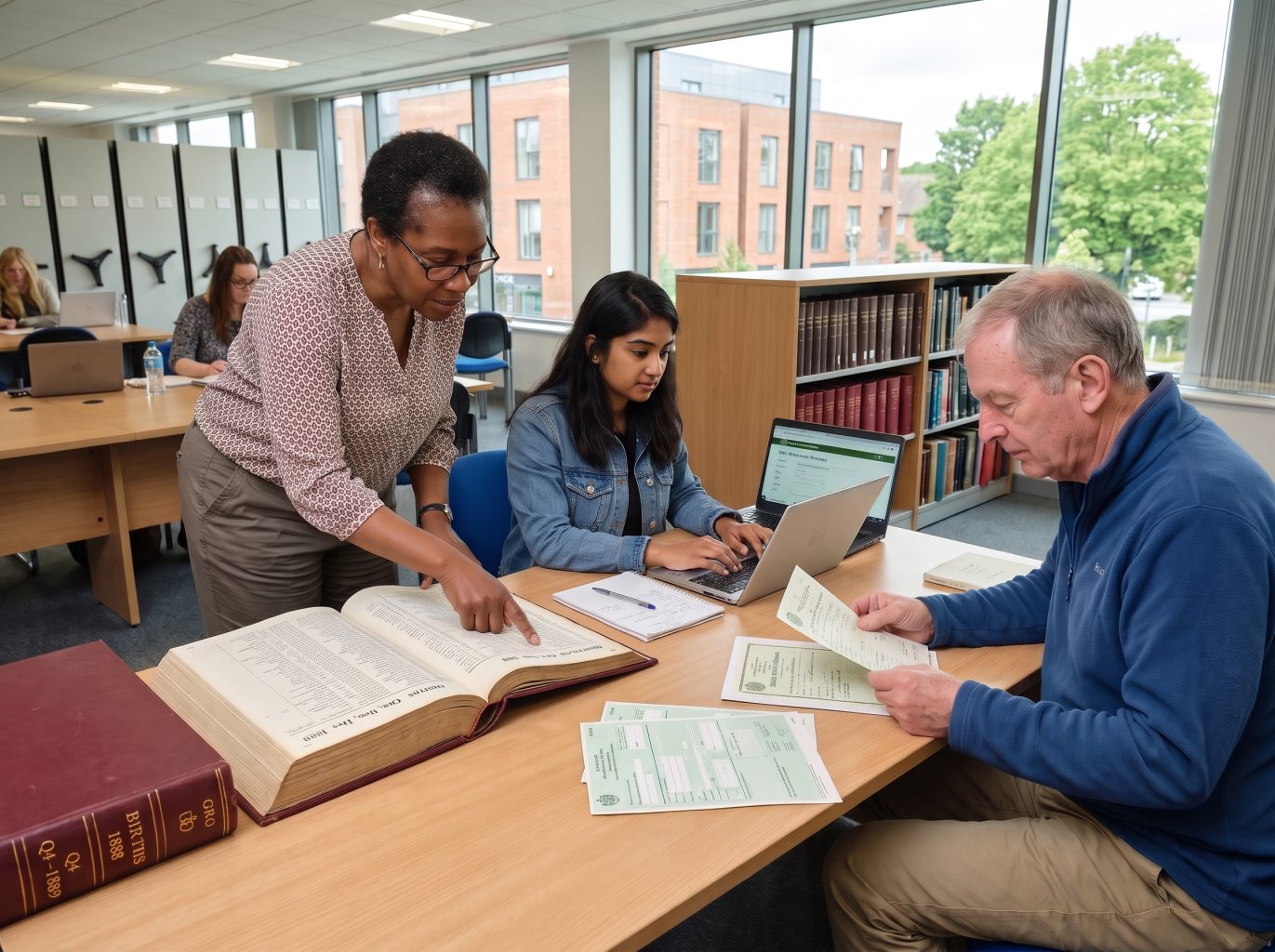
Our Family Research Centre at L14 London Road Campus, London Road, Reading RG1 5AQ gives you free access to the core resources for English and Welsh civil registration research:
- Findmypast – GRO civil registration indexes
- Ancestry (worldwide edition) – GRO civil registration indexes
- FreeBMD – free to search at home or at the Centre via https://www.freebmd.org.uk
- FamilySearch – we are a FamilySearch Affiliate Library, giving visitors access to additional digitised records not freely available online at home
- The Society’s shop offers some useful guide books which can be purchased either online via our website or face-to-face in the Family Research Centre. These include:
- “Birth and Baptism Records for Family Historians” https://berksfhs.org/product/birth-and-baptism-records-for-family-historians/, “Researching Adoption: An essential guide to tracing your birth relatives and ancestors https://berksfhs.org/product/researching-adoption-an-essential-guide-to-tracing-your-birth-relatives-and-ancestors/,
- “Marriage records for Family Historians” https://berksfhs.org/product/marriage-records-for-family-historians/,
- “Marriage Laws, Rites, Records and Customs” https://berksfhs.org/product/marriage-laws-rites-records-customs/,
- “Marriage Indexes for Family Historians” https://berksfhs.org/product/marriage-indexes-for-family-historians-gibson-guide/, “Marriage Law for Genealogy: The definitive guide” https://berksfhs.org/product/marriage-law-for-genealogists-the-definitive-guide/,
- and “Death and Burial Records for Family Historians” https://berksfhs.org/product/death-and-burial-records-for-family-historians/.
Our experienced Research Assistants are on hand to help. Check berksfhs.org for current opening hours.
Civil Registration – The Basics
Civil registration of births, marriages and deaths began in England and Wales on 1 July 1837. Before 1875 registration of births was not enforced and an estimated 10 per cent or more went unrecorded before that date. Some marriages also went unregistered before 1875. Almost all deaths were recorded, since a burial required a death or a coroner’s certificate. Civil registration records are neither 100 per cent accurate nor 100 per cent complete – always treat them as strong evidence rather than infallible fact.
Registration is organised by registration district – an administrative unit created for this purpose that does not map directly onto parish or county boundaries. England and Wales were divided into around 600 registration districts in 1837, each sub-divided into sub-districts. Knowing the registration district for a place is essential for understanding GRO references and for ordering the correct certificates. The registration district for any location can be identified via GENUKI, the FamilySearch wiki or the A Vision of Britain website at https://www.visionofbritain.org.uk.
For Scotland, registration began in January 1855; for Ireland from January 1864 (though Protestant and civil marriages were recorded from April 1845).
The General Register Office (GRO)
https://www.gro.gov.uk Access: Free to search indexes; charges for certificates
The GRO holds the national record of all births, marriages and deaths registered in England and Wales from 1 July 1837. It does not hold original registers – those remain with local register offices – but it holds central indexes and issues certified copies of entries (certificates).
The national indexes are based on quarterly returns until 1984, and annual returns thereafter. Names appear alphabetically by surname, with forename, registration district, volume number and page number. To order a copy certificate you will need the full GRO reference – name, year, quarter, district, volume and page number. For example: WINDSOR, Charles P A G, 1948, Dec, Westminster, 5c, 460.
What a Certificate Contains
Birth certificate: when and where born; forename (if given – babies were not always named immediately, and you may see entries such as “LUCAS Male” or “LUCAS Infant”); sex; father’s forename and surname (if recorded); mother’s forename, surname and maiden surname; father’s occupation; name, description and residence of informant; when registered (notionally within 42 days, but births late in a quarter were often registered in the following quarter).
Marriage certificate: place of marriage; date; forenames and surnames of both parties; ages (which may not be accurate); condition (bachelor/spinster/divorced/widower/widow); residence at time of marriage; fathers’ forenames, surnames and occupations; whether by banns or licence; signatures of parties, witnesses and minister or registrar.
Death certificate: when and where died; name; sex; age as given by informant (may not be accurate – reported ages for adults are frequently wrong, depending on who the informant was); occupation; cause(s) of death; name, description and residence of informant, and their relationship to the deceased (required after 1875); when registered.
Note that ages – particularly before 1900 – are frequently inaccurate across all certificate types. Treat them as an approximate guide rather than a definitive statement. Until 1969, birth certificates did not include the mother’s maiden name for illegitimate births. A bride may have been married more than once – always look for the groom’s name first when searching marriage indexes. And never assume that a marriage preceded a first birth by at least nine months.
Ordering Certificates
Online (simplest): https://www.gro.gov.uk/gro/content/certificates – you need to set up a free account first. With the full GRO reference you can order downloadable PDF images of birth records 1837-1917 and death records 1837-1957, or full copy certificates for births, deaths, marriages, civil partnerships and adoptions. You will be notified by email when a PDF is ready.
By phone: General Register Office: 0300 123 1837
Local register office: often cheaper and faster than the GRO for events registered in that district.
For full details of costs and help including YouTube guides, see the GRO FAQ at https://www.gro.gov.uk/gro/content/certificates/faq.asp
Never pay more than the GRO’s own prices by using a third-party certificate ordering website.
Searching the Civil Registration Indexes
Where to Search
|
Resource |
Coverage |
Access |
|---|---|---|
|
FreeBMD https://www.freebmd.org.uk |
births, marriages, deaths 1837-c.1983 |
Free anywhere – try this first |
|
births 1837-1934 and 1984 – c. 2 years ago; deaths 1837-1957 and 1984 – c. 2 years ago. |
Free anywhere – register with email |
|
|
Findmypast https://www.findmypast.co.uk |
births and deaths 1837-2006; marriages 1837-2005 |
Free at the Family Research Centre |
|
The Genealogist https://www.thegenealogist.co.uk |
births, marriages, deaths 1837-2005 |
Free at the Family Research Centre |
|
Ancestry https://www.ancestry.co.uk |
births, marriages, deaths 1837-2005 |
Free at the Family Research Centre |
Always search FreeBMD first – it is free anywhere, covers the period most researchers use most, and is often sufficient to find the GRO reference needed to order a certificate. (Use GRO Online for later years, rather than FreeBMD.) The subscription platforms are also useful because they sometimes have different transcriptions of the same entry – an ancestor missed on one platform may be found on another. They also have Marriages, which are missing from GRO Online.
Understanding GRO References
A GRO index entry gives: surname; forenames; registration district; volume number; page number; and the year and quarter (March, June, September or December) in which the event was registered. Note that the quarter of registration is not necessarily the quarter in which the event occurred – a birth in late March might not be registered until the following quarter.
The mother’s maiden name is shown in all birth indexes on the GRO website, but only from Quarter 3 of 1911 on FreeBMD. From 1912, the surname of spouse was added to marriages. From 1866, age at death appears in death indexes. From 1984, date of birth appears in death indexes.
Why You May Not Find an Event
- Before 1875 registration was not compulsory – an estimated 10 per cent of births and some marriages went unregistered.
- Babies were not always named at once – look for entries such as “LUCAS Male”, “LUCAS Female” or “LUCAS Infant”.
- A birth late in a quarter (say, late March) was often not registered until the following quarter (June) – so it appears a quarter later than you might expect.
- A bride may have been married more than once – search for the groom’s name first.
- A marriage sometimes followed the birth of the first child, and often preceded it by only days or weeks. Make no assumptions.
- Couples often lived as man and wife without marrying. Divorce was rare and expensive.
- A death may not have occurred where a person lived – hospital and workhouse deaths were recorded in the registration district where the institution stood.
- If an inquest followed a death, the registration date may be later than expected.
- Reported ages at death may not be accurate, depending on who the informant was.
- The event may have taken place outside England and Wales.
- People were not always known by the name shown on official documents.
- Early on, names were often spelt phonetically in the records.
Local BMD Indexes
UKBMD https://www.ukbmd.org.uk/local is a gateway to websites with indexes of original (local register office) records. A local reference from these indexes will allow you to obtain a copy certificate directly from the local register office, which is often cheaper than ordering via the GRO.
Beyond the GRO – Other Civil Registration Records
Superintendent Registrar’s Copies
Local register offices hold the original registers for their district. The local register office for any district can be found via https://www.gov.uk/register-offices. For some events where the GRO copy has been damaged, the local register office may hold the only surviving copy.
Overseas, At Sea and Military Registration
The GRO holds registers of births, marriages and deaths occurring overseas and at sea where these were registered by British consular officers or military chaplains. These are searchable via the GRO online index and via Findmypast and Ancestry. Records include the Army and Navy chaplains’ registers, registers of deaths at sea, and consular records from around the world.
Adopted Children
Adoption registers began in 1927, when legal adoption was first introduced in England and Wales. The Adopted Children Register is held by the GRO. Adopted people over 18 may apply for their original birth certificate and may access the Adoption Contact Register. The GRO guidance at https://www.gro.gov.uk/gro/content/adoptions/ explains the process.
Key Websites and Resources
FreeBMD https://www.freebmd.org.uk – Free GRO index searches 1837 onwards
GRO Online https://www.gro.gov.uk/gro/content/certificates/indexes_search.asp – Free GRO index for births and deaths 1837-1957; certificate ordering
A Vision of Britain https://www.visionofbritain.org.uk – Registration district identification and historical boundary maps
UKBMD https://www.ukbmd.org.uk – Gateway to local BMD indexes produced by county groups, sometimes more detailed than the GRO index
This guide was compiled by Berkshire Family History Society. https://berksfhs.org Links verified April 2026. Access terms, opening hours and record availability change – always check the current position on each site before visiting or searching.
