
Table of Contents
Introduction
Two key dates in your research are Saturday, 1 July 1837 – the start of civil registration in England & Wales – and Sunday, 6 June 1841 – when, for the first time on that particular census night, the national census collected names and some limited personal information of every person in the household. But if you need to search before 1837, what other resources can you use?
To find ancestors before 1837, or to learn more about people who were born, married or who died before that year, you must turn to parish records. While many different parish records survive, Church of England parish registers of baptisms, marriages and burials should be your starting point. Earliest registers date from 1538 (but many parishes did not begin to keep records until much later) and registers are kept to this day, offering valuable information for researchers.
Registers of baptisms are particularly important. In the early years of civil registration (from July 1837 to 1875), it is estimated that up to 15 per cent of births went unrecorded in some areas (for a variety of reasons). The baptismal record thus remains a key record even in the early years of civil registration.
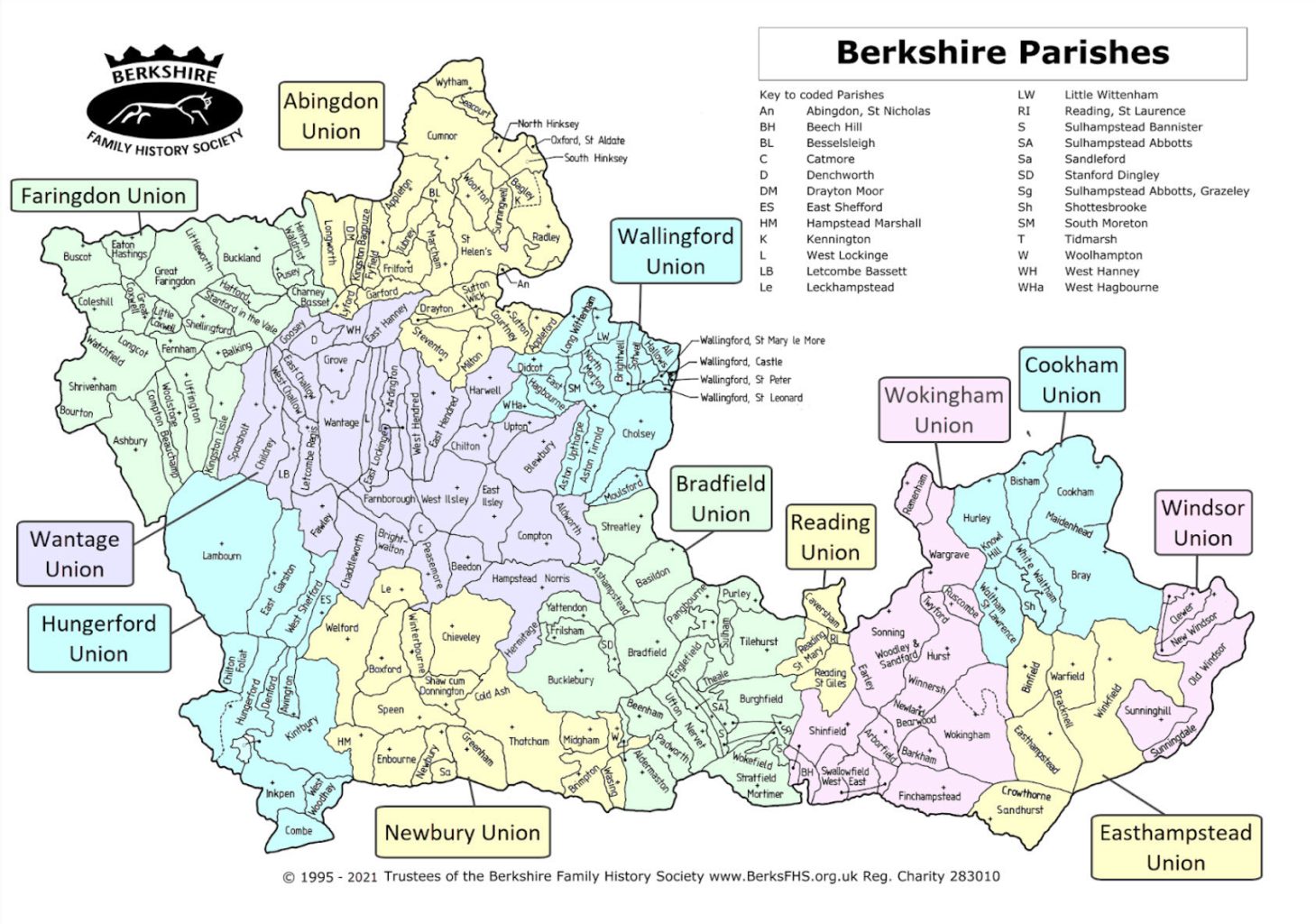
Those parish registers that are over 100 years old should now be safely deposited in the relevant diocesan archive, usually the County Record Office (CRO) or its metropolitan equivalent. For all of pre-1974 Berkshire (including parishes of North Berkshire and the Vale of the White Horse), original registers and other parish documents are held at The Royal Berkshire Archives in Reading.
Finding your ancestor in church records is rarely as straightforward as searching for them in civil registration and census records. You need to know how best to make intelligent use of available finding aids and indexes to parish registers. And you need to be able to use other research resources that can help you to find the right parish register for your needs.
What transcriptions and indexes are available? And how readily can you use them?
Searching Berkshire Parish Registers
Berkshire Baptisms, Marriages (incl Banns) and Burials
Volunteers are working hard to build a database of these events for pre-1974 Berkshire. The work is done in stages with updates released at appropriate times.
The information is released in a variety of forms:
- County-wide CDs – available in our shop
- Individual Parish Registers – available in our shop
- Data Downloads – available in our shop
- Feeds to Findmypast (only a subset of our transcriptions is available via FMP. Marginal or additional notes on our CDs and Data Downloads are omitted, because it doesn’t fit their format. The most complete transcription is available only from us)
- Finally, with effect from September 2026, Berkshire Parish Registers are available on Ancestry
The county-wide CDs are great value if you’re researching many Berkshire ancestors but if your researches are narrower, Data Downloads offer a cheaper on instantly accessible alternative that you can purchase from our shop (see top menu). Search by location in the search bar at the top of this page to see availability and prices
Parish Register transcriptions
If many of your ancestors were living in one particular Berkshire town or village for some time, you may also be interested in the transcribed registers of those specific places. Society volunteers have transcribed parish registers (that is births, marriages (including banns) and burials) of a number of pre-1974 Berkshire parishes and project work continues to add more. Search by location in the search bar at the top of this page to see availability and prices
Other sources
Other groups and individuals have indexed or transcribed records of some parishes in a variety of traditional (non-electronic) formats. You can see their outputs at Berkshire Record Office, the Society of Genealogists and in some local studies collections within the county.
If you would like to help with work on any current Berkshire project, you can find out what is involved on the main Projects page (You do not have to live in or close to Berkshire to play a useful part in project work, although some tasks (like checking against original records) can only be completed with convenient access to Berkshire Record Office in Reading.)
NOTE: Copyright and database rights subsist on all indexes and transcriptions of parish register entries produced by the society.
You must take great care at all times not to infringe those rights. Care is essential both in your use of information and, in particular, when sharing information with others.
Sharing information informally, or posting details publicly — online on a message board or discussion list in response to an enquiry, for example – could constitute a serious infringement of copyright and database rights.
Unauthorised use or incorporation of another party’s indexes or transcriptions in any other shared or published form or database is an infringement of rights and could have civil or criminal consequences. Written permission should always be sought from the rights-holder. To apply for such permission from us in respect of content we own, please use the Help > Contact menu item.
International Genealogical Index (IGI)
The International Genealogical Index (IGI) is a family history database listing several hundred million names of deceased people from countries throughout the world. The individual names in the IGI came from two sources. Families either submitted details to the Church of Jesus Christ of Latter-day Saints (LDS or Mormons), or volunteer teams abstracted and indexed details from original records. The IGI was first published in 1973 and was closed in 2008, but is still possible to search this database.
You will then need to create a FamilySearch account to take matters further. Visitors to our Family Research Centre on the University of Reading’s London Road Campus will be able to access this, and many other Family Search databases because Berkshire FHS is a Family Search Affiliate Library.
Even today, the IGI can be a useful finding aid. It is free to use and, if used with care, can often be helpful in research. But it does have numerous limitations. Note that the IGI does not contain all parish registers from a particular location, it does not cover all time periods, nor does it include all parishes. In many cases, entire parishes are missing. Except for some burials of infants and young children, the IGI contains no indexed burial information
Using Berkshire as an example, many parishes are included, at least in part, in the IGI but information is far from complete.
You should also be aware that some IGI data was derived from Bishops’ Transcripts and not from original registers. This has the potential to introduce disparities from the original entries and an additional level of transcription. (See below)
Some Berkshire parishes (and parishes in other counties too) are missing in entirety, or nearly so. Significant Berkshire omissions include Kintbury St Mary, Newbury St Nicholas, Reading St Laurence and Wargrave St Mary.
There are also significant gaps in the time periods covered and, for many parishes, indexed details stop at 1812.
Help in using the IGI
To discover which parishes and time periods (not just for Berkshire but for all counties) are included – and, equally important, those that are omitted – in the IGI, there is a website that may help you.
You may find it easier (especially if you are fairly new to family history research) to check first on the parishes and time periods included in the IGI. You can do this by visiting Steve Archer’s website FamilySearch: a Guide to the British batches
You can then search quite specific batches of parish records — remembering each time to change Batch Numbers as you search for different people in different parishes
- This particular website, confined to UK content, explains the IGI in more detail;
- Includes British batches added since 2002, especially ‘I’ batches;
- Provides a detailed analysis of ‘mixed’ batches – where the LDS included data from more than one place;
- Assigns places to mid-19th century historic counties. For example, if you consider entries for ‘London’, these are assigned to the City of London, Middlesex, Surrey or Kent
- Lists the number of entries (life events) per batch and dates covered, obtained from the data itself; and
- Includes some summary statistics.
Final words of advice on the IGI.
You cannot build an entire family tree from information found solely online or just from the IGI – even if names and places look, superficially, to be correct. The IGI is a ‘secondary’ rather than a ‘primary’ source of information. Should you find entries in a secondary source, like the IGI, that might be relevant to your research, you then need to look at the original records (the primary sources) and to confirm those details. The original registers will be accessible in the relevant county record office or metropolitan archive. In some cases, but certainly not all, digital images of register pages may be available to view online.
Always satisfy yourself that any indexed or transcribed information is accurate, correct and, most important, complete. Many original register entries contain important and relevant additional detail that is not recorded in the IGI itself.
The Royal Berkshire Archives
The Royal Berkshire Archives is a designated diocesan archive for the Diocese of Oxford, of which the Archdeaconry of Berkshire forms a part. It holds original registers deposited by the parishes of pre-1974 Berkshire (including those of North Berkshire and those of the Vale of the White Horse). In a few cases, most notably Abingdon St Helens, parishes have been permitted to retain their registers.
In 1992, the Church of England made a requirement that all parish registers of baptisms and burials containing entries that are 150 years old or more should be closed and (in most cases) deposited in a diocesan record office. The order does not apply to a church’s copy of marriage registers after 1837 (copies of these entries should have been sent for entry into the civil registration system). In practice, most of these older marriage registers have been deposited too. In a record office, these old and very often fragile registers can be safely maintained under suitable storage conditions.
Bishops’ Transcripts (BTs)
From 1598 onwards, most parishes were required to furnish an annual copy for the bishop of those baptisms, marriages and burials that had been entered in the register in the preceding 12 months.
Some of these copies were constructed at the same time as the original register entries were made. Others were compiled retrospectively, once the year had ended. As a result, under both approaches, there are variations (sometimes providing vital missing details for family historians) between entries in a parish register and the corresponding transcripts prepared for the bishop.
Once prepared, bishops’ transcripts were sent to the bishop of the diocese holding authority over the parish. There are a few instances of bishops’ transcripts before 1598 and the transcripts mostly ceased around 1837 with the arrival of the civil registration process. A very few BTs extend into the mid-19th century.
Many bishops’ transcripts have been lost or destroyed but there are situations where BTs survive while the original register has been lost. This makes BTs a potentially valuable resource in your research. Where both registers and bishops’ transcripts survive, it is good practice to check both, and compare the entry detail. As explained earlier, there will be inevitable differences for some entries – offering you a challenge — which source should you accept in your research?
Surviving BTs for Berkshire are held in the Wiltshire and Swindon History Centre (the Berkshire Archdeaconry formed part of the Salisbury Diocese until 1836). For the few BTs prepared subsequently, original returns are held in the Oxfordshire History Centre (after the 1836 transfer of the Berkshire Archdeaconry the Oxford Diocese).
North Berkshire
Berkshire Family History Society is the only society to cover all of pre-1974 Berkshire. It’s Baptisms, Marriages and Burials CDs provide county wide coverage.
Its Abingdon (Vale) Team provides a focal point for family historians living in North Berkshire.
Following changes to modern county boundaries in 1974, some North Berkshire parish registers have also been indexed or transcribed by the Oxfordshire Family History Society (OFHS). Reflecting techniques and materials used, most of these OFHS outputs are not as readily searchable as Berkshire Family History Society CD publications. Most of these Oxfordshire publications are available from our shop. Search by location in the search bar at the top of this page to see availability and prices.
Suggested further reading
An Historical Atlas of Berkshire, 2nd edition, December 2012, Editors Joan Dils and Margaret Yates, published by Berkshire Record Society (and available from our shop)
Phillimore Atlas and Index of Parish Registers, 3rd edition (2003) by Cecil R. Humphery-Smith
National Index of Parish Registers Volume 8 Part 1 Berkshire (2003) by Anthony Wilcox, published by the Society of Genealogists (and available from our shop)
