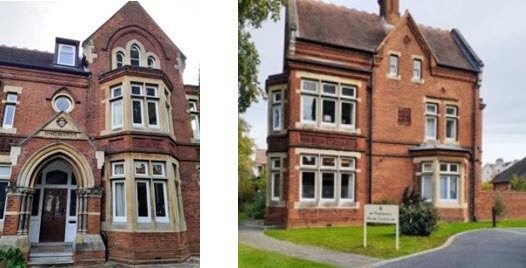
The main aim of my stay in Windsor was to take a picture of St Edward’s Presbytery, Alma Road, a building designed by my great grandfather Patrick James Byrne. However my query to the Berkshire Family History Society before I travelled to the UK from my home in Australia meant that I achieved far more than that. Member, Mike Bailey, not only researched the life of and achievements of Patrick James in Windsor using local resources, but also followed up information on Patrick’s father in law, my great great grandfather, the Honourable Captain Samuel Scoltock, a Military Knight of Windsor.
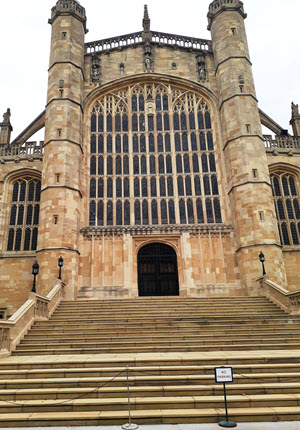
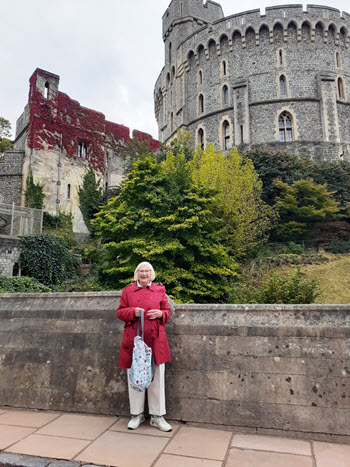
Mike was ready with information and prepared to show me around. First stop was Windsor Castle, where I had time to visit the royal apartments (absolutely stunning artworks, furnishings and dinner sets). Then off to the Archives of St George’s Chapel.
This is the chapel where the Royal members of the Royal family are often photographed attending services and where the late Queen, Elizabeth II, is interred. The Military Knights of Windsor are the guardians of St George’s Chapel, and lead any ceremonies there.
My ancestor, the Hon. Captain Samuel Scoltock, was one such dignitary. So I was taken down into the archives to view material prepared for me by the archivist, Kate McQuillian. The Military Knights were paid according to their attendance at chapel and this was recorded in attendance registers. From the 12th Century attendance 3 times a day was compulsory, but Queen Victoria relaxed that attendance requirement.
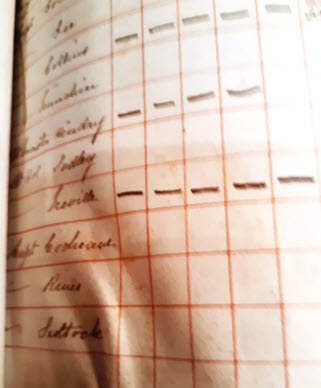
Relevant volumes for my purposes were VA 12, 13 1857-1866 showing the arrival of the Hon. Captain Scoltock as a Military Knight, his attendance and the date of his death.
Sorry this is not the best picture but you can see his name at the bottom which means he was a new member. The black lines you see show the attendance at chapel. In his earlier days there Samuel attended chapel 3 or 4 times a week, but in his last few years he recorded nil attendances, probably because of illness. In the archives was also one letter from Samuel’s wife Ellen (nee McKenna) explaining their difficult financial position.
From the archives it was time for a guided tour of the chapel and surrounds with a present day Military Knight, Lt Colonel John Moody, a very charming fellow. He explained that you applied to become a Military Knight after distinguished service in the Army, and were then interviewed. If successful you then had to wait for a vacancy before being admitted as numbers were strictly limited. The Knights are accommodated in quarters near the chapel. It was here that Samuel lived with his wife Ellen and daughter Barbara Catherine Mary from the early 1860’s to 1870. Lt Colonel John Moody explained that Samuel had been a mess manager and must have given outstanding service and was consequently made Honorary Captain. He was a member of the Devonshire Regiment and had served in India.
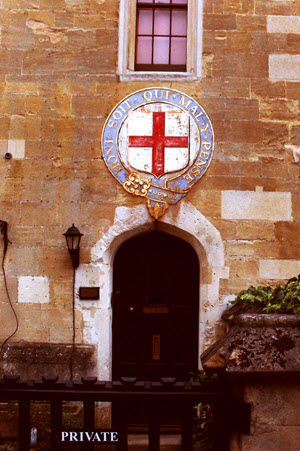 Our guide felt that it was unlikely that Samuel would have joined the army at ten years of age as suggested by Ancestry.com, who also list him as enlisted with the 46th (South Devonshire) Regiment of Foot with service in North America. (Perhaps we need a bit more research here!)
He described a colourful ceremony led by the Military Knights when the Knights of the Garter held their traditional ceremony and procession there. We walked through the chapel, the burial place of royalty including Henry VIII. Then out onto the park-like grounds to see the military quarters where my ancestors lived. These photos are of the Military Knights Quarters, Windsor. Our guide apologised as he was unable to take me inside the quarters where Samuel and his family lived as the present occupants were away that week.
I encountered little new material on Ellen and Barbara on my visit to Windsor, but it did persuade me to look again at the material I had already.
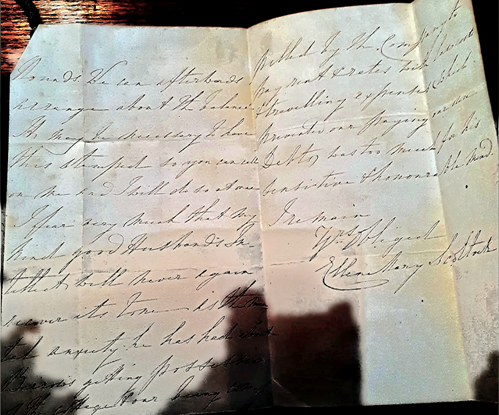
In one letter to a Scoltock relative after the death of her father, Barbara, aged 12, tells of her mother’s fears of leaving their residence in Windsor Castle. This would have further complicated their difficult financial position, and I believe may have affected her physical health.
My dear Cousin,
Now that I am home for my holiday my dear Mamma has given me the pleasure of acknowledging the receipt of your very kind letter of the 22nd of last month. She still continues her tho’ daily expecting an order to leave.
Our little garden looks very pretty and I have been busy in it all morning putting down some seeds. It is rather late in the season but my dear Mamma says she likes to see the flowers of my planting.. She wishes to congratulate you on your worthy uncle’s deserved promotion and hope that he will long live to enjoy the dignity.
The weather was very unpleasant on the day of the Queen’s Garden Party. Mamma said it was such a pity to see the rain pouring down on such beautiful violets and she thinks the doctor got employment from it.
You enquired of my favourite studies which are Painting, Music, Singing, Arithmetic, Writing and French Dialogue and Needlework; In fact I think I am fond of all my lessons.
With our united love to you, your Mamma (difficult to read next bit but it is something like) V cousin Sammel.
Believe me to be
Your loving little cousin.
Barbara Scoltock.
I have copied this letter to make it a little clearer. But I think it does in a simple way express something of their lives there, the uncertainty of the future, and the contact with the medical profession.
What happened to Ellen and Barbara after that? I gather that Ellen was ill, and that Barbara continued at school in London.
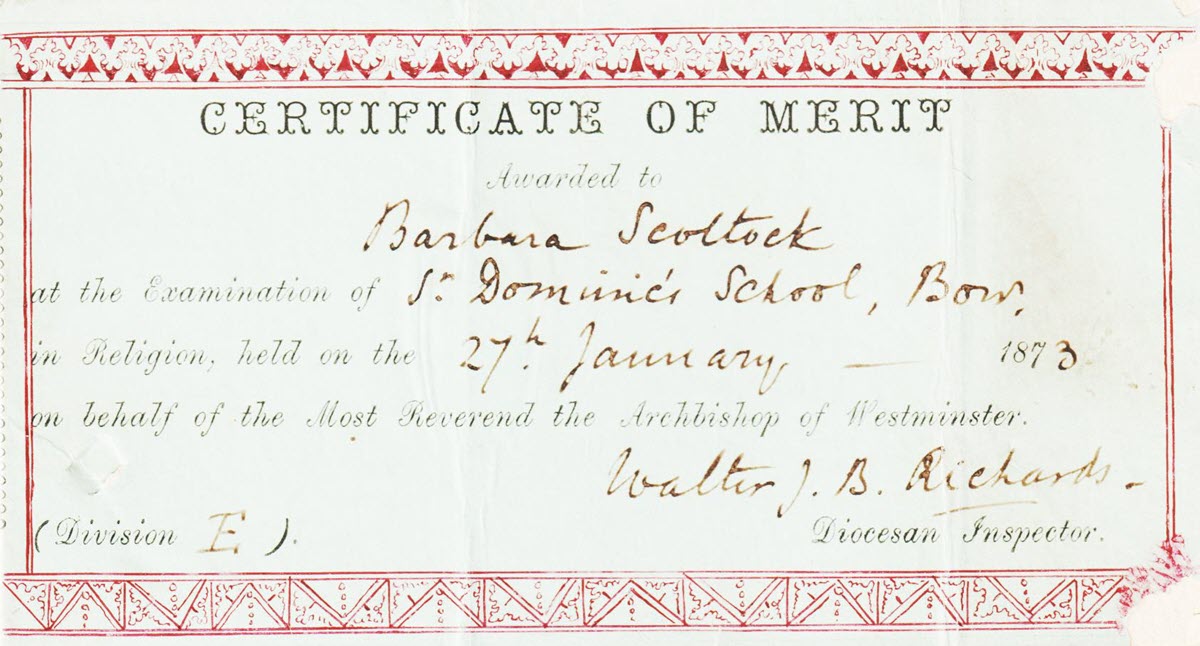
The next piece of evidence, located in the possession of an Aunt in Tasmania, is a letter from a convent in London informing the recipient that Barbara Scoltock has been in their care during her mother’s illness. She has now been transferred to an Aunt in America, her mother’s sister, to a convent there with the assistance of her guardian, Canon Applegarth, parish priest of Windsor.
St Catherine’s Convent
(Possibly) May 17
God is Love; Sm &Dc ( I think)
Dear Madam
In reply to your kind enquiries about Barbara Scoltock, we can only say that she was placed under our care during part of her poor mother’s illness and remained in our care twelve months, when, at the desire of her aunt and with the consent of her guardian the Rev W(?) Applegarth she left us to be consigned to the care of her Aunt, Miss McKenna religious Sister of Mercy in a Convent at Augusta in the United States. The Rev W Applegarth took her himself to Liverpool on the 29th April and saw her on board the Steamer (?), .Capt Hall placing her under the care of a Mrs Hall who was educated by the Sisters of Mercy at his Aunt’s convent. The vessel is not a steamer, but a first class merchant (indecipherable 4 letter word) being a sailing vessel. We have not yet had time to receive news of her arrival at New York where she was to be met by her friends. Barbara was a remarkably pleasing and interesting child and we were all much attached to her-all the more from her position so lonely and friendless.
Very truly yours in ?
Sister Mary Dorothea..
How long Barbara Catherine Mary stayed in America is uncertain. The next piece of evidence I have of Barbara Catherine Mary’s life is a marriage certificate signed by Canon Applegarth registering the marriage of Barbara Catherine Mary (age 17) to Patrick James Byrne thereby keeping the promise she had made as a small child “that she would marry him when she grew up”.
As if that wasn’t enough for one day, it was off to follow the footsteps of my great grandfather, Patrick James Byrne. Mike had provided me with a list of entries re Patrick Byrne from the Windsor and Eton Express.
|
Key points from a search of the Windsor & Eton Express archives for Patrick James Byrne, Architect |
||
|
Date |
Place of residence / business |
Event |
|
28 December 1872 |
4, Frances Road, Windsor 55, High-street, Windsor. |
Moved his Offices from 4, Frances Road to 55, High Street (Alexandra Chambers) |
|
10 May 1873 |
Alexandra Chambers, High Street |
Tenders for the erection of schools in accordance with the plans and specifications of Mr. P. J. Byrne, Architect |
|
12 July 1873 |
met Mr. Byrne on the spot. They removed some earth, and saw the sewage working round the cesspool. |
|
|
09 May 1874 |
55, High Street, Windsor 32, Park Street, Windsor (Alexandra Chambers) |
Moved his Offices from 55, High-street, Windsor to 32, Park Street, Windsor. The Office of the Rural Sanitary Inspector is also removed to the same address. |
|
08 January 1876 |
Great praise bestowed on the architect Mr P. J. Byrne, Windsor, and Messrs. Oades, of Egham, the contractors, for the manner in which the works have been executed, |
|
|
14 April 1877 |
7, Sheet Street, Windsor |
First mention of the Sheet Street address as a place of business (Did he need a new office away from his residence with the family growing?) |
|
15 May 1880 |
32, Park Street, Windsor |
Tender for new front to Mrs. Allen’s shop, Peascod Street, Windsor. |
|
08 July 1882 |
Mr. Patrick James Byrne, architect of Windsor, examined by Mr. Bothwell, gave evidence to the effect that the construction of this railway would cause the …. |
|
|
12 January 1884 |
The guests assembled in the room attached to the Star Inn, Peascod Street, the architect (Mr. Byrne) and 2 members of the firm of Oade. and Son, of Egham, being present. |
|
|
21 June 1884 |
The Old Literary Institute, Sheet Street, Windsor |
Messrs. Byrne & Wilmot, Architects, Surveyors, and Sanitary Engineers, Lyons Inn Chambers, 303, Strand, London, & Windsor notify their clients that they have removed their Windsor Offices from the Old Literary Institute, Sheet Street. |
|
01 November 1884 |
awarded Mr. P. J. Byrne A.R.I.B.A., architect, of Windsor, a bronze medal in the class of design for artisan’s dwellings and model lodgings for the poor. |
|
|
25 July 1885 |
summoned by Mr. Byrne, Inspector of Nuisances for the Windsor Union Rural Sanitary Authority, permitting a nuisance to arise from his slaughter-house, near Jutland Place, Clewer. |
|
|
29 May 1886 |
Clewer |
Patrick James Byrne, of Clewer, architect and surveyor, bankrupt, applied for his discharge, |
|
14 May 1887 |
Park-Street |
Patrick James Byrne, architect, Windsor, said he lived in Park-Street until the end of 1884 |
The list confirms the family legend of Patrick’s work on development of improved public sanitation, evidence of which I had seen previously in booklet form, sadly missing now. It also confirms a major contribution to housing for the poor, evidenced by his award of a bronze medal for work in this area. The mention of the name Wilmot of the Strand, London, as his partner, also confirms the family legend of a financial disagreement between the partners.
In all, this list of public involvement presents a picture of a talented man using his skills for his community.
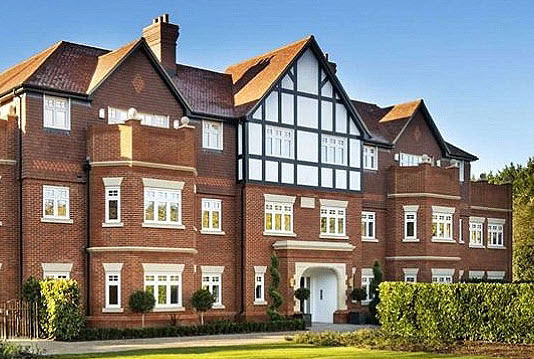
Our first stop was Orchard Lea, near Winkfield, designed by Byrne for Reginald Baliol Brett, Member of the House of Lords, a design for which Byrne received Royal acclaim.
The building is now described as commercial premises. However there was no sign of other buildings or activity and the whole area was stunning parkland.
Mike showed me the following description of Orchard Lea in “The Winkfield Chronicles” by researched and written by Rev. Simon Baynes and Ruth J C Timbrell and published by Winkfield History Project Group:
ORCHARD LEA
Orchard Lea, the estate at the junction of the Drift Road and Winkfield Lane, opposite Winkfield Place, was built by Reginald Baliol Brett (1852-1930) on land bought from his brother-in-law Victor Van de Weyer of New Lodge, in 1883-84, to the design of a young Irish architect, Patrick James Byrne. It is described by Brett’s biographer as “non-descript Tudoresque“, …………, but it was much admired by the future George V, and the Kaiser, who had the design copied in Germany.
The Royal Tapestry works was another major undertaking for Patrick Byrne. The idea was to train craftsmen skilled in tapestry to the highest international standard. A number of members of the Royal Family supported the project and Queen Victoria was the patron, giving permission to use the word Royal. Byrne designed the premises of workers’ cottages surrounding a central hall at Old Windsor.
Although I did not see what remains of this site, I felt it important to add this information as a further illustration of Byrne’s international standard as an architect and a supporter of the arts.
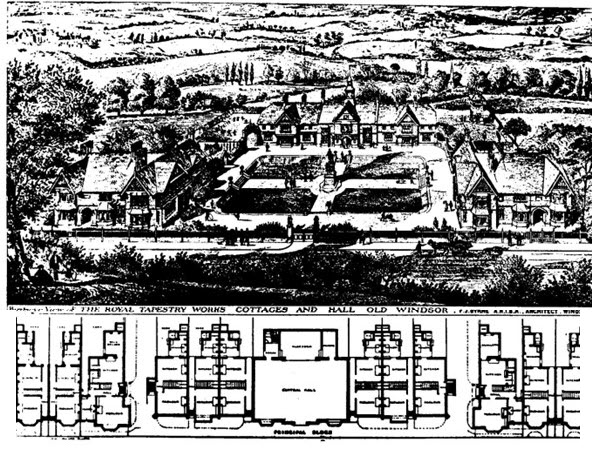
Note Byrne’s name as architect appears after the words OLD WINDSOR.
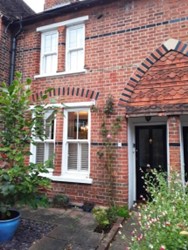
Next stop was Clewer where Byrne and his family moved from Park St. The houses of the main street have been remodelled but the photo shows some that would be similar to that occupied by Byrne and family. The atmosphere is one of peace and tranquillity. I wonder where the children went to school. My grandfather, William Joseph Byrne, spoke of attending a day school and spending his lunch money on “Penny Dreadfuls”.
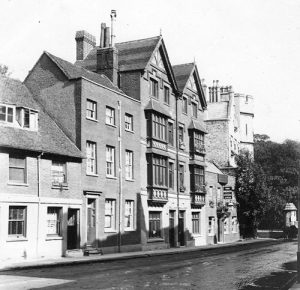
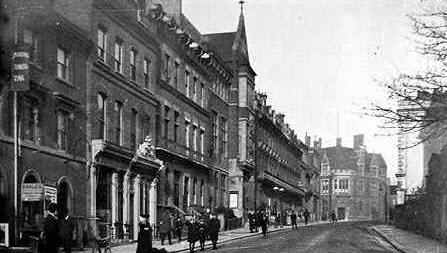
Moving on to Park St (left), situated just below Windsor Castle, is the area where Byrne lived and worked in his earlier days. No 32 has been redeveloped, but the Two Brewers Pub is still there.
A further site where Byrne’s offices were located for a time was Sheet Street.
What a day it was for me, so much exciting information and I really felt I was walking in the footsteps of my great grandfather. I cannot thank Mike Bailey enough for his research and personal help on this amazing day.
Windsor Day 2 was a much quieter day. A short walk took me to St Edward’s Presbytery, to get the photo which had been the main purpose of my Windsor visit. I was unable to enter the building as the occupant was away, but I did get photos from outside and through a window.