
Table of Contents
How BerksFHS Can Help With Welsh Research
Berkshire Family History Society’s strapline is for family historians wherever you’re from – and that very much includes researchers tracing Welsh ancestors.
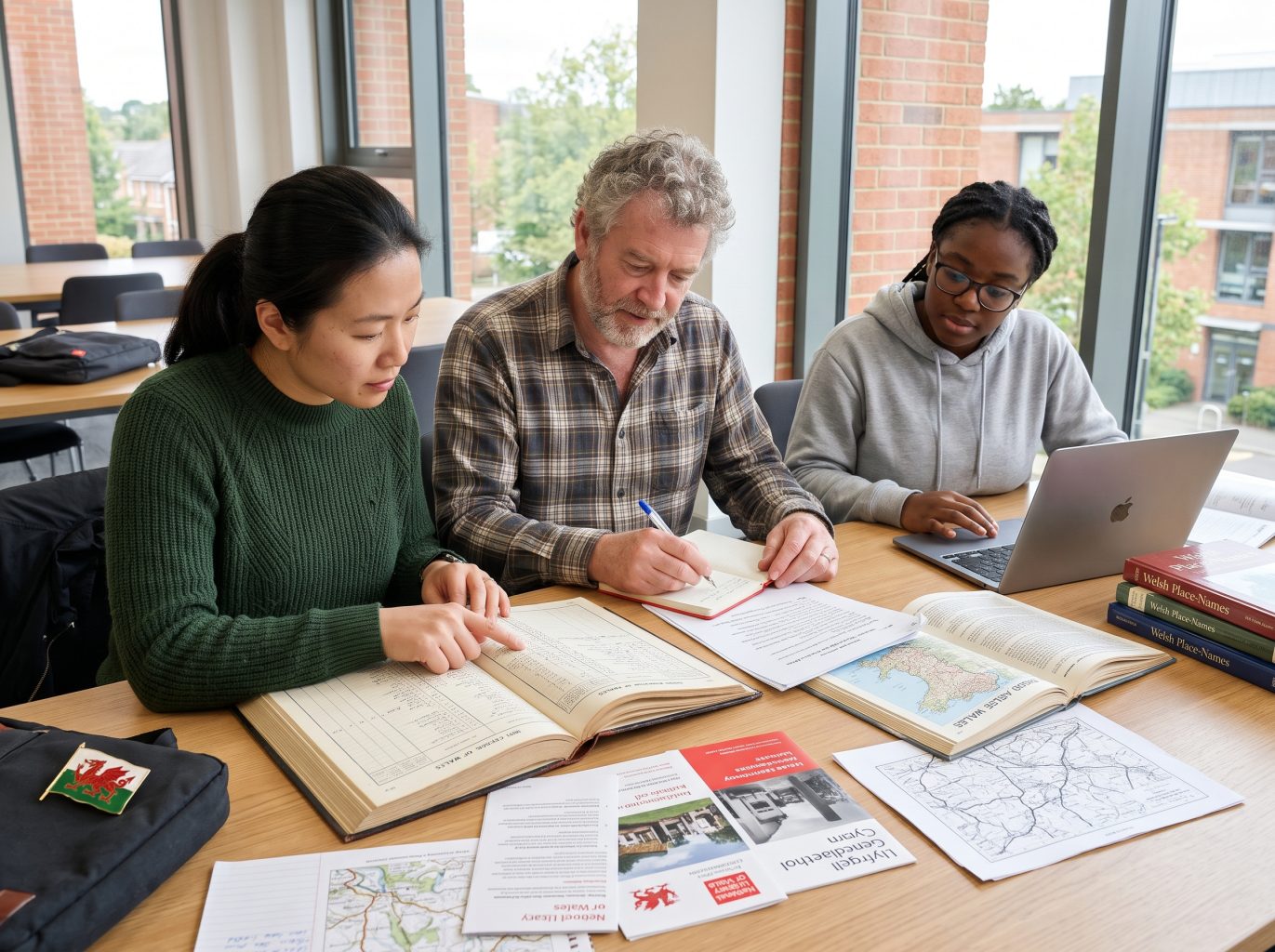
Our Family Research Centre at L14 London Road Campus, London Road, Reading RG1 5AQ offers something genuinely exceptional: free access, in a single visit, to all of the following:
- Findmypast – the largest collection of Welsh parish register transcriptions and images available online, plus census records, civil registration, newspapers and military records
- Ancestry (worldwide edition) – census records 1841-1921, civil registration indexes and a growing collection of Welsh parish records
- The Genealogist – additional Welsh record sets including nonconformist registers
- The British Newspaper Archive – Welsh newspaper titles alongside English ones
- FamilySearch – we are a FamilySearch Affiliate Library, which means visitors have access to digitised records not freely available online at home, including Welsh civil registration indexes and parish register transcriptions
- Our bookshop (purchase can be made in the FRC & online) contains “Researching Family History in Wales” https://berksfhs.org/product/researching-family-history-in-wales/
All of this is free to anyone who walks through our door, although donations towards our running costs are warmly welcomed. Our experienced Research Assistants are on hand to help you search effectively, understand what you’ve found, and decide where to go next. Check berksfhs.org for current opening hours before visiting.
When you are ready to go further into original Welsh records, the National Library of Wales in Aberystwyth is the principal destination. County record offices across Wales also hold substantial local collections; Archives Wales will identify which office is relevant for a specific area. The Association of Family History Societies of Wales (https://www.fhswales.org.uk/) lists member societies by county.
Wales is Different – More Than You Might Expect
Because England and Wales share the same civil registration system, the same census records and many of the same national archives, it is tempting to treat Welsh research as simply English research with a different geography. That would be a mistake. Welsh genealogy has two challenges that have no equivalent in English research and which, if not understood from the start, will bring your research to a halt surprisingly quickly.
The Naming Problem
Welsh surnames present a challenge unlike anything in English genealogy. The problem has two distinct parts.
Part one: the patronymic system. Until well into the 19th century, Wales used a patronymic naming system in which a child took the father’s first name as their surname, which changed with every generation. A son of Rhys ap Hywel – that is, Rhys son of Hywel – might be called Evan ap Rhys or simply Evan Rhys. Evan’s own son would not be Evan Rhys Junior; he would be Thomas ap Evan, or Thomas Evan, or Thomas Evans. The surname changed with every generation. For daughters, the prefix was ferch or verch (daughter of), so Rhys’s daughter might be recorded as Sian ferch Rhys.
When families began adopting fixed surnames – broadly from the 16th century for gentry, and trickling through the community to the early 19th century in rural areas – they most commonly froze the father’s first name as the family surname, often adding a possessive ‘s’. So the descendants of a man called Evan became Evans; the descendants of John became Jones; of David became Davies or Davis; of Hugh became Hughes. This explains why there are so few Welsh surnames and so heavily concentrated.
There is a further complication. When ap (son of) was joined directly to a name beginning with certain consonants, the ‘p’ fused with it. So ap Rhys became Price or Pryce; ap Hywel became Powell; ap Owen became Bowen; ap Hugh became Pugh; ab Evan became Bevan. If your ancestor is named Powell, Price, Bowen, Pugh or Bevan, they almost certainly have an ancestor called Hywel, Rhys, Owen, Hugh or Evan respectively.
The practical consequence for researchers is severe. You cannot assume that two people with the same surname in the same parish are related or that siblings share a surname. You cannot trace a Welsh family by surname alone in any record before about 1800 in rural areas, because the surname may not yet have been fixed.
Part two: the concentration of surnames. Even after fixed surnames became universal, the pool of Welsh surnames remained tiny. In any given parish in the 1800s you may find dozens of unrelated families named Jones, Davies and Williams. The key to distinguishing them is the combination of first name, township or farm name, and parish – not surname alone. Families were often identified by their farm or holding name, which appears in some records but not all. .
The Language Problem
Welsh was the first language of the majority of the population until well into the 20th century. This has several practical consequences:
- Pre-civil-registration records, including parish registers, may be partly or entirely in Welsh
- Place names may be in Welsh, in anglicised Welsh, or in English, and these can look very different. The village of Llanfair in Welsh may appear as St Mary’s in an English record. Farm names are almost always in Welsh
- Census returns from Welsh-speaking areas were sometimes completed in Welsh, and census enumerators sometimes struggled with Welsh names & places, producing errors
- Nonconformist chapel records are frequently in Welsh
- Gravestones in chapelyard cemeteries are often in Welsh
You do not need to speak Welsh to research Welsh ancestors, but you do need to be aware that a name or place you are searching for may appear in a different form than you expect, and that some documents will require translation assistance.
The Church Problem
Between 1754 and 1837, all marriages in England and Wales (except Quakers and Jews) had to take place in the Church of England under Hardwicke’s Marriage Act. However, baptisms were a different matter. By the mid-19th century roughly three quarters of the Welsh population were Nonconformist – that is, they worshipped in Baptist, Independent/Congregationalist, Calvinistic Methodist or Wesleyan Methodist chapels rather than in the parish church. So, if your Welsh ancestor was Nonconformist – you will not find their baptism in the parish register. You need to find their chapel. Nonconformist records are more scattered and less consistently preserved than Anglican ones, and many chapel registers do not start until the 1800s or later. Finding the right chapel for your ancestor’s family is one of the central tasks of Welsh research.
Note also that the Church of England was the established church in Wales until 1920, when it was disestablished and became the Church in Wales. Records created before 1920 are Anglican parish records; from 1920 they are Church in Wales records.
The One Repository That Changes Everything
National Library of Wales (NLW) / Llyfrgell Genedlaethol Cymru
https://www.library.wales/ Access: Free (most online resources); Reader’s Ticket for full in-person and some online access
For Welsh research, the essential archive is the National Library of Wales in Aberystwyth. It is the central repository for Welsh genealogical material and has no real equivalent anywhere else. Its holdings relevant to family history include:
- Parish registers on microfilm for nearly 500 Welsh parishes
- All Bishop’s Transcripts from Welsh dioceses
- The Church in Wales Archive – baptisms, marriages, burials, wills and marriage bonds
- Nonconformist chapel records – the most significant Welsh collection outside The National Archives at Kew
- Wills proved in Welsh ecclesiastical courts before 1858 (fully indexed & viewable online)
- Marriage bonds and allegations 1616-1837 (indexed online)
- All Welsh tithe maps and apportionment schedules (free online via Places of Wales)
- 15 million newspaper articles 1804-1919 (free online via Welsh Newspapers Online)
- 1.2 million pages from Welsh journals 1735-2007 (free online)
- Estate records, manorial records, pedigrees and family papers
- Electoral registers and Quarter Sessions records
- The Court of Great Sessions criminal records 1543-1830 (crime and punishment database online)
- 950,000 historic photographs
- 1.5 million maps including 300,000 tithe map entries
Many of these resources are freely accessible online. Others require a Reader’s Ticket, which can be registered for free online and provides additional access from home for Wales residents, with further access in person in Aberystwyth.
NLW Family History help pages: https://www.library.wales/catalogues-searching/help-to-search/family-history-help/help
Essential Free Online Resources
Welsh Newspapers Online
https://newspapers.library.wales/ Access: Free
Over 15 million articles and 1.1 million pages from nearly 120 Welsh newspaper titles, generally up to 1910. Both Welsh-language and English-language titles are included. An outstanding free resource for birth, marriage and death notices, obituaries, local news, court reports and social history. Unlike the British Newspaper Archive, access is completely free. Published by the NLW.
Places of Wales – Tithe Maps
https://places.library.wales/ Access: Free
Over 300,000 searchable entries from the tithe maps of Wales and accompanying apportionment documents. The tithe maps (1838-1850) are the most detailed maps of their period and cover more than 95% of Wales. Each map is accompanied by a written schedule listing the names of landowners and occupiers, land use and in most cases field names. Essential for placing a rural ancestor in their landscape and identifying landholding before the census era.
Archives Wales
https://archiveswales.org.uk/ Access: Free
The single-search hub for over 7,000 Welsh archive collections across 21 Welsh archives – the Welsh equivalent of The National Archives’ Discovery catalogue. The ‘Find your archive’ tab lists all contributing archives with descriptions, contact details and links. This is the most efficient way to find which Welsh archive holds records relevant to a specific place, person or institution.
FamilySearch – Wales
https://www.familysearch.org/en/wiki/Wales_Genealogy Access: Free
Free indexes to Welsh civil registration records, some parish register transcriptions, and detailed wiki guides to Welsh research by county. As a FamilySearch Affiliate Library, BerksFHS gives visitors access to additional digitised records not freely available online at home. The Wales Naming Customs wiki (https://www.familysearch.org/en/wiki/Wales_Naming_Customs) is particularly valuable for understanding the patronymic system before you start searching.
GENUKI – Wales
https://www.genuki.org.uk/big/wal/ Access: Free
A volunteer-maintained directory organised by county, covering archives, church records, civil registration, census, newspapers and local societies. The county guides explain boundary changes and the particular challenges of Welsh naming conventions in each area.
Dictionary of Welsh Biography
https://biography.wales/ Access: Free
Over 5,000 biographies of people who made a significant contribution to Welsh life. Useful for researching notable ancestors and for understanding the cultural context of Welsh communities.
Civil Registration and Census
Welsh civil registration and census records are part of the same systems as England – the same GRO indexes, the same census years, the same access routes. However, there are practical points specific to Welsh research:
Civil registration began on 1 July 1837 for England and Wales together. Certificates are ordered from the General Register Office or from the local register office. The GRO index is searchable free at https://www.freebmd.org.uk/ and via Ancestry, Findmypast and FindMyPast. The NLW holds microfiche copies of the GRO indexes from 1837 to 1998 and provides free access to Ancestry and Findmypast in its reading rooms.
Census returns for Wales 1841-1921 are available on the same subscription platforms as for England (Ancestry, Findmypast etc). Note that census returns from Welsh-speaking areas may record residents as Welsh speakers, which can help confirm you have the right family, and some returns were partially completed in Welsh.
North Wales BMD (https://www.northwalesbmd.org.uk/) is an ongoing volunteer project indexing births, marriages and deaths from local register offices in North Wales from 1837, providing an alternative route into civil registration records.
A Suggested Research Path
- Establish the county or region your ancestors came from as early as possible – this is even more critical in Wales than in England, given the concentration of surnames
- Read the FamilySearch Wales Naming Customs wiki before you start searching. Understanding patronymics will save considerable wasted effort
- Identify religion – Anglican or Nonconformist. If Nonconformist, which chapel? GENUKI county pages and Archives Wales will help identify what records survive
- Search civil registration via FreeBMD, Ancestry or Findmypast for ancestors after 1837
- Search census records – particularly useful in Wales as they often record Welsh-language ability, and addresses may give farm or holding names that help pin down a location
- Search the NLW’s online resources – particularly Welsh Newspapers Online and the pre-1858 wills index
- Use Places of Wales to search tithe maps for your ancestor’s area, identifying landowners and occupiers around 1840
- Search Anglican parish registers via Findmypast, Ancestry or the NLW microfilm collection
- Track down chapel records via Archives Wales, the NLW and local county archives for Nonconformist ancestors
This guide was compiled by Berkshire Family History Society. https://berksfhs.org Links verified May 2026. Access terms, opening hours and record availability change – always check the current position on each site before visiting or searching.
