
Table of Contents
Before You Start – Scotland is Different
If you are used to researching English and Welsh ancestors, Scotland will feel familiar in many ways but there are some important differences to understand before you begin.
Civil registration began later. Births, marriages and deaths were not registered by the state until 1 January 1855 – nearly ten years after England and Wales. Before that date, the only systematic records are church registers.
The calendar changed earlier. Scotland adopted the Gregorian calendar in 1600, a full 152 years before England. When working with pre-1752 dates in Scottish documents, they will usually already be in the “new style” – unlike English records of the same period.
The church was different. The established church in Scotland was (and is) the Church of Scotland, which is Presbyterian, not Anglican. Its records are called Old Parish Registers (OPRs) – the term ‘Old’ distinguishing them from the statutory registers that began in 1855, not implying any comparison with English record types. There were also significant numbers of Roman Catholics, particularly in the Highlands and the west, and various dissenting Presbyterian churches. Not everyone had their life events recorded in the Church of Scotland registers.
Legal terms are different. What England calls “probate” is called “confirmation” in Scotland. A “will” is a “testament”. The executor is confirmed by a court, and every testament includes an inventory of the deceased’s possessions – making them particularly rich for family historians.
Women kept their names. In Scotland, women never officially lost their maiden surname after marriage. You may find a widow recorded under her maiden name rather than her married name, particularly in later life.
Clans are not universal. The clan system was a Highlands and Borders phenomenon. Lowland Scots families were not part of the clan structure – so do not assume that a Lowland surname implies clan membership.
Highland naming patterns. In Highland and Island families, given names were traditionally passed down in a specific order: the first son was named after the father’s father, the second son after the mother’s father, the third son after the father himself, and so on. The same pattern applied to daughters. Recognising this convention can help you work backwards through generations, but be aware that the same names therefore recur frequently within a family.
Surnames could change. In the Highlands, it was common practice to adopt the surname of the local landowner or clan chief. A man named Donald MacKenzie may have had a father with a completely different surname. This makes Highland research particularly challenging before the 19th century.
How BerksFHS Can Help With Scottish Research
Berkshire Family History Society’s strapline is for family historians wherever you’re from – and that very much includes researchers tracing Scottish ancestors.
Our Family Research Centre at L14 London Road Campus, London Road, Reading RG1 5AQ offers something genuinely exceptional: free access, in a single visit, to all of the following:
- Findmypast – extensive Scottish parish register transcriptions, census records, newspapers and military records
- Ancestry (worldwide edition) – census records, civil registration indexes, parish records and specialist Scottish collections
- The Genealogist – additional Scottish record sets
- The British Newspaper Archive – Scottish newspaper titles alongside English ones
- FamilySearch – we are a FamilySearch Affiliate Library, which means visitors have access to digitised records not freely available online at home, including Scottish births and baptisms 1564-1950, marriages 1561-1910 and much more.
- Our bookshop (available in the FRC and online) contains “My Ancestor was Scottish” https://berksfhs.org/product/my-ancestor-was-scottish/ & “Researching Scottish FH” https://berksfhs.org/product/researching-scottish-family-history/
All of this is free to anyone who walks through our door, although donations are always welcomed towards our running costs. And our experienced Research Assistants are on hand to help you search effectively, understand what you’ve found, and decide where to go next. Check berksfhs.org for current opening hours before visiting.
When you are ready to go further into original records not available on any online platform, the two most productive destinations for a dedicated Scottish research visit are the ScotlandsPeople Centre in Edinburgh (General Register House, 2 Princes Street – book in advance via https://www.scotlandspeople.gov.uk/visit-us) and, for Highland and Island research, the Highland Archive Centre in Inverness. The Scottish Genealogy Society (15 Victoria Terrace, Edinburgh) welcomes visitors to its library.
The One Site You Cannot Do Without
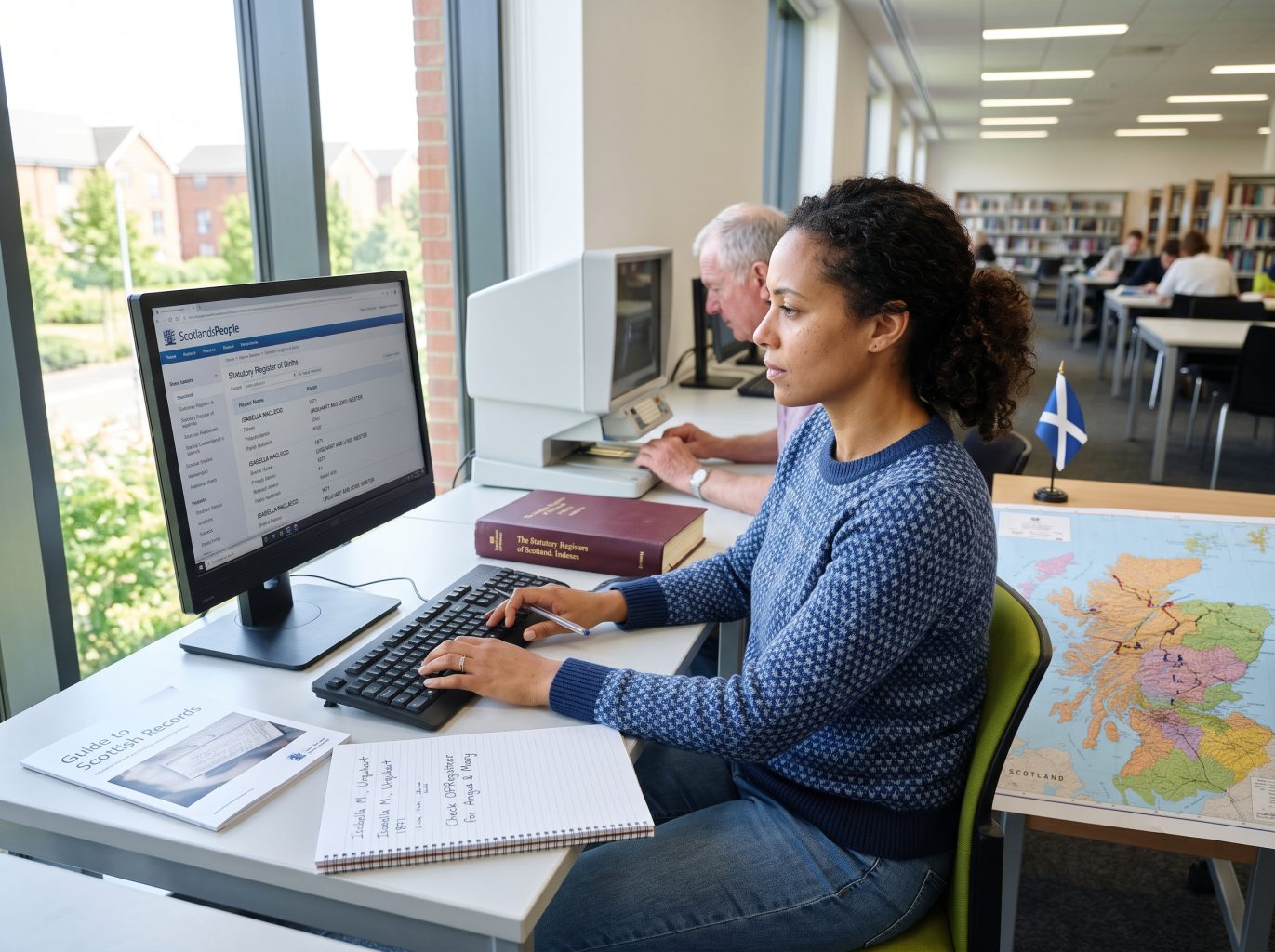
ScotlandsPeople
https://www.scotlandspeople.gov.uk/ Access: Free to search indexes; pay-per-view credits to view record images
ScotlandsPeople is the official Scottish Government genealogy website, operated by the National Records of Scotland (NRS). It is the essential starting point and will be central to your research throughout. No other site gives you access to the same breadth and depth of Scottish records.
You must register for a free account before you can search. Once registered, you can search all indexes at no cost. You only pay when you want to view and download an image of the original record. Credits are purchased in blocks and do not expire. You can also order paper copies of certificates via their website.
ScotlandsPeople holds:
- Civil registration records – statutory births, marriages and deaths from 1 January 1855 to the present. Digital images are subject to closure periods: births are closed for 100 years, marriages for 75 years, deaths for 50 years. The BMD record indexes however, are available, up until the present. Divorces are also available from 1984, Civil Partnerships from 2005, and Dissolution of Civil Partnerships from 2007.
- Old Parish Registers (OPRs) – Church of Scotland baptisms, marriages and burials from 1553 onwards. Coverage is patchy before the mid-18th century. Some Roman Catholic and dissenting church registers are also included.
- Census returns – 1841 to 1921, fully indexed by personal name. The 1921 census for Scotland is only available on ScotlandsPeople. (Transcriptions of other censuses are available on Ancestry and FindmyPast) whilst the 1939 Register is not yet available.
- Wills and testaments – over 611,000 entries from 1513 to 1925. Their format is different to English wills, and may only list the deceased’s assets, not who inherited them.
- Valuation rolls – lists of property owners and occupiers in every Scottish county and burgh from 1855 to 1996, useful between census years for tracking where a family lived. They are also cheaper than most other records on the site.
- Kirk session records – Church of Scotland court records from 1560 to 1870, available to browse free of charge through the “Virtual Volumes” feature. These can be a goldmine for social history and for tracing people who do not appear clearly in other records.
- Poor relief and emigration records – including Highland and Island Emigration Society passenger lists 1852-57.
- Prison registers – to 1921.
- Soldiers’ and airmen’s wills and military service appeal tribunal records.
The ScotlandsPeople Centre in Edinburgh (General Register House, 2 Princes Street) offers in-person access to all digitised records and expert staff assistance. Register in advance and book a seat. This is the place to go if you are making a dedicated research trip to Scotland.
Record Guides A-Z: https://www.scotlandspeople.gov.uk/guides/1503/408 – free guides to every record type on the site, essential reading before you start searching.
Free Supporting Resources
National Records of Scotland – Research Guides
https://www.nrscotland.gov.uk/research/guides/a-z Access: Free
The NRS publishes over 50 free research guides covering every major Scottish record type – censuses, church records, military records, wills, poor law, valuation rolls and more. Read these before you begin searching, as they will tell you what records exist, what they contain, and what their limitations are. An essential and often overlooked resource.
FamilySearch – Scotland
https://www.familysearch.org/en/wiki/Scotland_Genealogy Access: Free
The world’s largest free genealogy database. For Scotland, FamilySearch holds free-to- search indexes of births and baptisms 1564-1950 and marriages 1561-1910, plus an 1881 census transcription. The Scotland Genealogy wiki is an excellent free introduction to Scottish records. As a FamilySearch Affiliate Library, BerksFHS gives visitors access to additional digitised records not available online at home. Indexes can contain transcription errors, so treat them as a finding aid and verify against the original record on FamilySearch or ScotlandsPeople.
National Library of Scotland – Family History
https://nls.uk/family-history Access: Free
An overview of the resources available at the NLS and how to access them. The NLS holds extensive newspaper collections, maps, directories and published family and clan histories. Its Digital Gallery (https://digital.nls.uk/gallery) has 99 galleries of texts and illustrations providing invaluable social and historical context.
GENUKI – Scotland
https://www.genuki.org.uk/big/sct/ Access: Free
A volunteer-maintained directory organised by county and record type. Use it to identify what records exist for a specific area and to find local resources that commercial search engines may miss. Coverage is variable – around a third of counties are in “care and maintenance” – but it remains a valuable first port of call for county-level research.
FreeCen
https://freecen2.freecen.org.uk Access: Free
Volunteer transcriptions of 19th century census returns. Particularly useful for Scotland for the 1841 and 1851 censuses, though coverage is incomplete. Use as a finding aid and verify the result on ScotlandsPeople.
Scottish Handwriting – A Vital Skill
Records before about 1750 were written in Secretary Hand, a script that looks very different from modern handwriting and requires some practice to read. Do not be put off – there are excellent resources to help, including one published by BerksFHS itself.
A Secretary Hand, an ABC Book – BerksFHS
https://berksfhs.org/product/a-secretary-hand-abc-book/ (print) – ISBN: 1 85163 081 3 – Editions: 1982, 2000, 2019. Also available as a PDF download: https://berksfhs.org/product/secretary-hand-abc-book-pdf/
The standard teaching text on Secretary Hand, covers illustrated letter forms A to Z, common abbreviations, practice words, numbers, and sample transcripts of wills from the 16th to 18th centuries. Widely used by palaeography educators and directly applicable to Scottish documents – Scottish and English Secretary Hand share the same core letterforms. Supplement it with the Scottish-specific tutorial below when working on Scottish documents.
Scottish Handwriting Tutorials – ScotlandsPeople
https://www.scottishhandwriting.com/ Access: Free
Free online tutorials specifically for Scottish documents, covering the 16th, 17th and 18th centuries. An ideal companion to Alf Ison’s book – it focuses on Scottish document types, Scots vocabulary and local conventions rather than teaching Secretary Hand from scratch. Includes a one-hour introduction for beginners, advanced exercises on court records and testaments, and a weekly practice “poser”. Work through these before attempting pre-1750 original documents on ScotlandsPeople.
Dictionary of the Scots Language
https://dsl.ac.uk/ Access: Free
When you encounter unfamiliar words in older Scottish documents – and you will – this is the reference to reach for. It combines the Dictionary of the Older Scottish Tongue (to 1700) and the Scottish National Dictionary (1700 onwards), and is freely searchable online. The archaic Scots vocabulary in testaments and court records can be as challenging as the handwriting itself.
A Suggested Research Path
If you are starting from scratch, this sequence will serve most researchers well:
- Gather what you already know – names, approximate dates, and any family stories about Scottish origins. The more specific the starting point, the more productive your early searches will be.
- Read the NRS Research Guides for the record types you expect to use – at minimum, the guides to statutory registers, census returns and church registers.
- Register for a free ScotlandsPeople account and search the indexes for the names and dates you have. Do not purchase credits yet – exhaust the free index searches first.
- Check FamilySearch for any free records that may help you work backwards before committing credits on ScotlandsPeople.
- Identify the parish your ancestors came from as early as possible. Most Scottish records are organised by parish. GENUKI will help you understand what survives for a specific parish and where it is held.
- Purchase credits on ScotlandsPeople once you have a clear target – a specific record you need to see. The credits-based model rewards focused searching.
- Read the Scottish Handwriting tutorials as soon as you move into pre-1855 OPR records, where handwriting quality and script styles vary considerably.
This guide was compiled by Berkshire Family History Society. https://berksfhs.org Links verified May 2026. Access terms, opening hours and record availability change – always check the current position on each site before visiting or searching.
