
Table of Contents
How BerksFHS Can Help
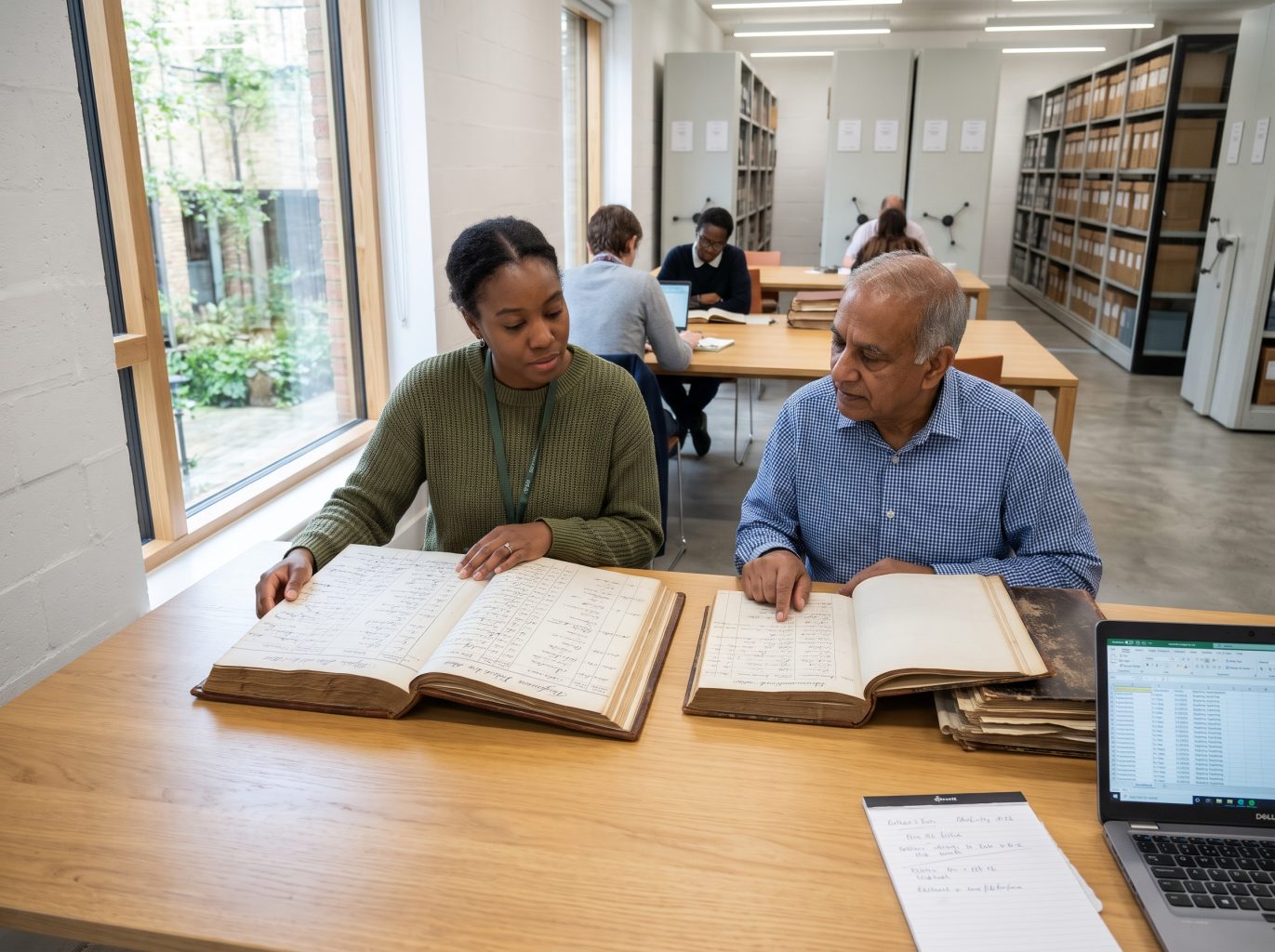
Our Family Research Centre at L14 London Road Campus, London Road, Reading RG1 5AQ gives you free access to the main platforms for church record research:
- Findmypast – the largest collection of English and Welsh parish register transcriptions and images online, plus the nonconformist RG series from TNA
- Ancestry – extensive parish register collections and nonconformist records
- The Genealogist – TNA’s official partner for nonconformist records online, with over 8 million records from the RG series
- FamilySearch – free indexes to baptisms, marriages and burials. We are a FamilySearch Affiliate Library, giving access to many original images not available online at home
- Our PCs hold copies of almost two million baptism, marriage and burial register entries from the historic county of Berkshire. These are indexed and easily searchable
- In addition, you can purchase your own copy of these transcriptions, and Berkshire’s marriage bonds, to use at home, from our shop either online or face-to-face in the Family Research Centre. The shop also sells “A Secretary Hand, an ABC Book” by Alf Ison, the standard teaching text for reading pre-1750 English documents
- Our reference library contains a number of useful books to aid your research, including the 3rd edition of “Phillimore’s Atlas and Index of Parish Registers”
Our experienced Research Assistants are on hand to help. Check berksfhs.org for current opening hours.
The Framework: What Records Exist and When
Church records are the primary genealogical source for England before civil registration began in 1837. Understanding when each type of record begins, what it contains, and where it is held is the foundation of pre-Victorian research.
Parish Registers – The Starting Point
Parish registers were introduced in 1538 when Thomas Cromwell ordered every parish in England to keep a register of baptisms, marriages and burials. In practice, survival before about 1600 is patchy. The most useful records for most researchers begin in the 17th or 18th century, though some parishes have continuous registers from 1538.
Early registers recorded minimal information. A baptism entry might give only the date, the child’s name and the father’s name. A burial entry might give only the date and the deceased’s name. Marriages were similarly sparse. This changed in stages, see below for the key changes.
What Parish Registers Contain
Baptisms record: date of baptism; child’s name; father’s name; mother’s name (from 1812); father’s occupation (from 1812); parish.
Banns record (from 1754): date banns read, names of bride and groom, their parish & marital status, why the banns were abandoned (if applicable), marriage date (sometimes)
Marriages record (from 1754): date; names of parties; whether by banns or licence; signatures or marks of parties and witnesses; name of officiating minister. Before 1754, records are often just a date and two names.
Burials record: date; name; abode (from 1812); age (from 1812). Cause of death does not usually appear in burial registers, although fatalities caused by accidents or diseases such as smallpox were sometimes recorded.
Bishop’s Transcripts (BTs)
From 1598, parishes were required to send annual copies of their register entries to the bishop of the diocese. These copies – Bishop’s Transcripts can survive where the original register has been lost or damaged, and can also supplement the original register where entries are illegible.
BTs are held at the relevant diocesan record office or county record office. They are often not complete as parishes were often irregular in sending them. Where both the original register and the BT survive, it is worth checking both: occasional entries appear in one but not the other, and the copyist sometimes recorded additional detail not in the original.
BTs are increasingly available online via Findmypast and Ancestry, particularly for counties where the county archives have undertaken digitisation partnerships. Berkshire’s BTs are held at the Wiltshire and Swindon History Centre.
Marriage Licences, Bonds and Allegations
An alternative to marriage by banns, a marriage licence allowed a couple to marry without the three weeks of public announcements (banns) required by church law. Licences were popular with the wealthy, with those marrying in a hurry, and with nonconformists who preferred not to advertise their Anglican marriage. The allegation was a sworn statement by one of the parties (usually the groom) that there was no legal impediment to the marriage; the bond was a financial guarantee. These documents often contain more detail than the register entry itself, including ages, occupations and places of residence.
Marriage licences were issued by ecclesiastical authorities – the bishop, archdeacon or, for the most prestigious (and legally widest-ranging) licences, the Faculty Office or Vicar General of the Archbishop of Canterbury. Records are held at county record offices and at Lambeth Palace Library. Many have been indexed and some are available online via Findmypast and Ancestry.
Boyd’s Marriage Index, compiled by Percival Boyd, covers around seven million marriage entries from 1538 to 1837 drawn from registers, BTs and marriage licences. Coverage is strongest for East Anglia, Yorkshire and Cambridgeshire. Available on Findmypast.
Where Parish Registers Are Held
The majority of original Anglican parish registers are now held at the relevant county record office, following a large-scale transfer from parish custody during the 20th century. Some registers remain with the church, particularly for more recent years.
Finding the right record office: Use the Discovery catalogue at The National Archives (https://discovery.nationalarchives.gov.uk) to search by parish name. The FamilySearch England Genealogy wiki provides county-by-county guidance on holdings. GENUKI county pages list individual parish register holdings with dates.
Online access: A substantial and growing proportion of English parish registers are available online via Findmypast and Ancestry, with Findmypast generally having the stronger English coverage, although usually these are transcriptions. FamilySearch holds free indexes to many collections and also many images. Coverage varies widely by county – some counties have near-complete digitisation, others very little. The Online Parish Clerks project (https://www.onlineparishclerks.org.uk) provides free volunteer-compiled indexes for a growing number of counties. FreeReg (https://www.freereg.org.uk) also provides free transcriptions of a number of registers, though coverage is uneven.
The Society of Genealogists’ library holds the largest collection of parish register transcripts and copies outside the record offices, with coverage of about 10,000 of England’s roughly 12,500 ancient parishes. Holdings are strongest for the southern counties. The SoG catalogue can be searched online at https://sog.org.uk.
Nonconformist Records
A significant proportion of the English population – particularly from the 18th century onwards – did not worship in the Church of England.
The Core Problem: Marriages Before 1837
Between 1754 and 1837, Hardwicke’s Marriage Act required all marriages in England (except Quakers and Jews) to take place in the Church of England. This means that Methodist, Baptist, Congregationalist, Catholic and other nonconformist marriages before 1837 will almost certainly be in Anglican marriage registers, not in the records of the congregation to which the couple belonged. Their baptisms and burials, however, may be in nonconformist registers.
After 1837, nonconformist chapels could register marriages, though until 1899 a civil registrar had to be present. Nonconformist marriage registers therefore mostly date from 1837 onwards.
The TNA Nonconformist Collections – RG 4, RG 5, RG 6, RG 8
In 1837, a government commission collected nonconformist registers from congregations across England and Wales to authenticate them for legal purposes. A second commission followed in 1857. The resulting collections at The National Archives are the most comprehensive source for pre-1837 nonconformist records:
- RG 4 – Registers surrendered to the 1837 commission: Baptist, Independent, Presbyterian, Methodist, Moravian, Huguenot and other congregations
- RG 5 – Birth certificates from the Protestant Dissenters’ Registry at Dr Williams’ Library (Baptists, Independents and Presbyterians, 1716-1837) and the Wesleyan Methodist Metropolitan Registry (1773-1838)
- RG 6 – Society of Friends (Quaker) registers, 1578-1841
- RG 8 – Registers surrendered to the 1857 commission: additional nonconformist and some Catholic registers
The Genealogist is TNA’s official online partner for the nonconformist RG series, holding over 8 million records. Free at the Family Research Centre. Findmypast and Ancestry also hold substantial nonconformist collections.
Key Denominations and Their Records
Methodists (from 1739) were the largest nonconformist group in England by the 19th century. Records are in RG 4 (pre-1837) and then in circuit and chapel records, many held by local record offices. The Methodist Church archive is at the John Rylands Library, Manchester. BMDRegisters (https://www.bmdregisters.co.uk) indexes many Methodist records.
Baptists (from the early 17th century) held adult baptism rather than infant baptism, so their registers record births rather than baptisms. Records are in RG 4 (pre-1837) and then with individual congregations or the Baptist Union. The Baptist Historical Society (https://www.baptisthistory.org.uk) can assist with locating records.
Congregationalists / Independents (from the 17th century) – records in RG 4 (pre-1837) and then either in county record offices or individual congregations. Many later merged into the United Reformed Church. The Dr Williams’ Library in London (https://dwlib.co.uk) holds significant Congregational and Presbyterian archives.
Quakers (Society of Friends, from 1650s) kept meticulous registers of births, marriages and burials, organised by Monthly Meeting. The full Quaker RG 6 series covers 1578-1841 and is searchable online via Findmypast and Ancestry. Post-1837 records are with the Library of the Society of Friends (https://www.quaker.org.uk/resources/library).
Presbyterians / Unitarians – records from Dr Williams’ Library are in RG 4 and RG 5. The Unitarian Historical Society (https://www.unitarianhistory.org.uk) can advise on specific congregations.
Huguenots – French Protestant refugees arrived in significant numbers from the 1680s. Their London registers are largely in RG 4. The Huguenot Society (https://www.huguenotsociety.org.uk) holds extensive records and publications.
Roman Catholics – Catholic registers before 1837 are scattered and survival is uneven. Some are in RG 4 and RG 8; many remain with individual parishes or diocesan archive centres. The Catholic Family History Society (https://catholicfhs.online) and the relevant diocesan archives are the best starting points. Berkshire FHS’s reference library contains a large section of Catholic material.
Jews – Jewish records are held by individual synagogues and by the Jewish Genealogical Society of Great Britain (https://www.jgsgb.org.uk). Some records are available via Findmypast.
After 1837 – Other Nonconformist Records
Nonconformist chapel records often also record additional information – membership rolls, Sunday school registers, class records, ministers’ diaries and congregational minutes. These can be found either in county record offices, the denominations’ own archives, or at the chapels.
Reading Old Documents – Palaeography
Many older church registers were written in Secretary Hand. The same script was used across England, Scotland and Wales from the 16th to the early 18th century.
A Secretary Hand, an ABC Book by Alf Ison, published by Berkshire Family History Society, is the standard teaching text and is used by palaeography educators across the country. It covers letter forms A to Z, common abbreviations, numbers and practice transcripts of wills and other documents from the 16th to 18th centuries. Available from https://berksfhs.org/shop/.
The National Archives Palaeography Tutorial at https://www.nationalarchives.gov.uk/palaeography/ is a free interactive online tutorial using original documents from 1500 to 1800. Suitable for beginners and intermediate researchers.
Latin appears in many pre-1733 registers (Latin was required for legal record-keeping until Parliament abolished it in 1733). A useful free resource is the Latin tutorial at https://www.medievalgenealogy.org.uk/guide/pal.shtml.
A Note on Berkshire
BerksFHS volunteers have transcribed many parish registers held at the Royal Berkshire Archive, and many of these entries are searchable via Findmypast. The PCs in the Family Research Centre also hold transcriptions of baptism, banns, marriage and burial entries published by Berkshire FHS, including material not available on Findmypast. These are fully searchable by name and place.
Key Dates for Parish Registers
Understanding the legislation that shaped parish record-keeping helps explain why registers look the way they do in any given period – why some are sparse, why others are more detailed, why gaps appear, and why records were kept in different formats.
1538 – Decree by Thomas Cromwell requiring all parishes to keep registers of baptisms, marriages and burials. The decree was repeated in 1558 as compliance had been poor.
1597 (with effect from 1598) – Decree by Elizabeth I requiring parish records to be entered in bound registers written on parchment, and transcribed annually to the diocesan bishop. These copies are the Bishop’s Transcripts.
1642-1660 – Civil War and Commonwealth periods. Turmoil led to many registers not being maintained. Barebone’s Parliament made an unsuccessful attempt to introduce civil registration in 1653, with marriages to be performed by Justices of the Peace. This lasted only until 1660, but explains why some parishes have no entries for this period.
1666-1680 – Burial in Woollen Acts required the dead (except plague victims and the destitute) to be buried in English woollen shrouds. An affidavit had to be sworn confirming compliance; burial entries were to be marked “affidavit” or “naked” for those too poor to comply. The legislation remained in force until 1814 but was generally ignored after 1770.
1694 – Marriage Duty Act imposed duty on births, marriages and burials and an annual tax on bachelors over 25 and childless widowers. The aim was to raise money for the war with France. The tax failed to raise the expected sums and was abandoned in 1706.
1752 – Great Britain moved from the Old Style (Julian) calendar to the New Style (Gregorian) calendar. The official year moved back from 25 March to 1 January; 11 days were removed from September 1752 (2 September was followed by 14 September). Continental Europe had used the New Style calendar since 1582 and Scotland since 1600. Both Old Style and New Style dates can appear in registers from 1600 onwards, which may cause confusion.
1753 (with effect from 1754) – Hardwicke’s Marriage Act (“An Act for the Better Preventing of Clandestine Marriage”). Marriages now had to take place in an approved Anglican church (including those of Catholics and nonconformists); in the bride or groom’s parish; with two witnesses; after 21 days’ notice (banns) or by licence; and using specially printed registers. Quakers, Jews, marriages abroad and marriages in Scotland were exempted.
1782 – Stamp Act imposed duty of 3d on every Church of England register entry, except for paupers. Extended to nonconformist registers in 1785. The taxes could not be successfully enforced and the Act was repealed in 1794.
1812 (with effect from 1813) – Rose’s Act (“for better regulating and preserving Parish and other Registers”). Formalised record-keeping for baptisms and burials: printed register books were provided for each type of record (now kept in separate books); copies were to be sent annually to the diocese; baptisms and burials outside the parish church had to be notified to the minister for entry in the register. This is why the format and detail of baptism and burial registers improves noticeably after 1813.
1836 (with effect from 1 January 1837) – Marriage Act legalised civil marriages. Provided there was a registrar and two witnesses, marriages outside the Church of England could now take place in registered buildings.
1837 (with effect from 1 July 1837) – Births and Deaths Registration Act introduced civil registration of births, marriages and deaths. From this point the civil and church systems run in parallel.
This guide was compiled by Berkshire Family History Society. https://berksfhs.org Links verified April 2026. Access terms, opening hours and record availability change – always check the current position on each site before visiting or searching.
