
Introduction
My interest in the Alexander family stems from research related to families in the Wendlebury, Merton and Bicester area of Oxfordshire. Through the interesting history of the Dunkin family, our line eventually arrives at the family of Walter Hunt and his wife Margaret Alexander who married on 20 January 1577/8 in Bicester. In the 16th and early 17th centuries the Hunt family were prominent members of the local community and Walter who was a glover by trade formed part of the ruling oligarchy of the town in the late 16th century1.
Alexanders of Bicester1
Margaret Alexander was probably a daughter of Humfrey Alexander, weaver, and his wife Dorothy who made their wills in 1631 and 1637 respectively2. Walter Hunt made his will on 14 January 1621/22 and one of the beneficiaries was his son Humfry. Evidence for the link to Margaret comes from the fact that Humphry Hunt carried out the inventory of Humfrey Alexander’s goods in 1631. In this scenario, Humphry Hunt would have been his grandson since he was the only person of that name alive at the time in Bicester. Margaret had already died in 1618. Furthermore, the will of Dorothy Alexander in 1637 records Humphry Hunt as a debtor. So, in both wills there is reference to Margaret’s son.
It is likely that Humphry Alexander was the son of John Alexander, alias Millwarde, and his wife Margaret. John Alexander was buried in Bicester on 11 September 1573 having made his will in 15712. Probate was granted on 5 March 1573/4 and clearly indicates a man of some means since he owned several copyhold and freehold properties in Bicester and Buckingham. At the time his will was written he named six children as Richard, Thomas, Raffe, Humfry, John and Besse (Elizabeth). Their legacies are summarised as follows:
|
Child |
Legacy |
|
Richard |
The family home in Market End, Bicester, a copyhold property from the Lord of Derby |
|
Thomas |
A freehold property in Kings End, Bicester together with one yardland and a half and all the meadows, pasture and other commodities belonging to it |
|
Raffe |
A freehold property in Kings End, Bicester together with half a yardland and all the meadows, pasture and other commodities belonging to it |
|
Humfrey |
A shop in Buckingham occupied when the Will was written by John Alexander himself. He was also given another shop in Buckingham with all the lofts and premises belonging to it. |
|
John |
A house in Buckingham together with a smaller property and two tenements in the town occupied by poorer citizens. |
|
Besse (Elizabeth) |
A shop in Bicester market next to the forge. This was copyhold from the Lord of Derby |
All the said properties were to go to John’s wife, Margaret for her natural life along with the rest of the unbequeathed estate and thereafter as bequeathed. The properties in Kings End and Buckingham were to go, in perpetuity, to the longest survivor of the two sons nominated in each area. Two siblings are named in the Will as Harrye and Margaret.
It is possible, but unproven, that this family is represented in the Bicester parish records predominantly under the name of Milward with a name transition to Alexander in about 1561. This is described in the following table:
Children of John Millward and Margaret Martin, married 17 November1544
|
Baptism |
Child |
Burial |
Comment |
|
9 January 1545/6 |
Elizabeth |
Millward |
|
|
11 June 1547 |
Alice |
22 June 1547 |
Millward |
|
4 December 1548 |
Richard |
Millward |
|
|
26 February 1549/50 |
Alice |
Millward |
|
|
3 May 1551 |
Margarett |
April 23 1561* |
*Alexander alias Millward |
|
20 July 1552 |
Avis |
Millward |
|
|
10 February 1553/4 |
Thomas |
4 May 1557 |
Millward |
|
17 October 1555 |
Margery |
28 March 1557 |
Millward |
|
2 February 1556/7 |
Humfrey |
Millward |
|
|
28 December 1559 |
Thomas |
Milword alias Alexander |
|
|
6 April 1561 |
John |
Alexander |
|
|
23 October 1562 |
Ysabell |
Alexander |
|
|
26 April 1572 |
Dorothe |
Alexander |
Names in italics all feature in John Alexander’s Will. Raffe was a beneficiary, but his baptism has not been found. The other names are missing from the will, but John Alexander made bequests of £5 to each of his sons and daughters. Margaret Alexander, widow, was buried in Bicester on 26 April 1609 but seems not to have made a will.
A series of searches at the National Archives and Victoria County History led to the realisation that the combination of the Alexander surname with the alias Milward (or variants) was not unique in the area. Of note was the family who occupied the rectory at Caversham in the 16th and early 17th century some 40 miles to the south of Bicester. The obvious question then arose as to whether the families were related and if so how. The following study was, therefore, undertaken to crystallise and clarify family relationships in an attempt to identify any potential links between them.
The Caversham Family and its links to Hertfordshire, Buckinghamshire and Suffolk
Situated on the north bank of the Thames near Reading, Caversham Court and Gardens is a site steeped in history from medieval times. Knowledge surrounding the Court and the families who lived there has been collated by resident historian, Dr Gillian Clark, and summarised in a timeline available from the Royal Berkshire Archives3. This provides the background against which the following research has been carried out.
Caversham Court, also known as “The Old Rectory”, was one of the great Tudor houses of the parish built near the site of a medieval pilgrimage centre. It once served as the home of the rector of St. Peter’s Church but from Tudor times it became the home of private families. The first such family was that of William Alexander, alias Milward, and his wife Katherine who arrived as lay tenants in 1586 and remained until the early 17th century4. The descendants of William Alexander, alias Milward, and his wife Katherine have been described by Dr. Gillian Clark and are not considered here. In line with the dates surrounding the Bicester family emphasis has been placed instead on William Alexander’s generation and the potential links arising from a consideration of his kinsmen and potential ancestors.
It is well documented that Katherine was the daughter of Richard Warde of Hurst in Berkshire, sub-treasurer to Henry VIII. In his will of 1577, he named his daughter simply as Millward. However, in a Fine Roll5 from 1609/10 in which lands were to be delivered to the co-heirs of Sir Richard Warde, her brother, she is referred to as “Katherine Alexander, alias Milward, then wife of William Alexander alias Milward esq., a third sister of Ric. Warde.” At the time of her fathers death in 1605 she was 60 years of age.
William Alexander, alias Milward, seems to have spent his early years in Hertfordshire where in 1543 his father, also William Milward, alias Alexander, was granted tenure of substantial lands and properties which became known as the Bushey Hall estate6. In the following year he was granted a lease which covered “the rents of assize, perquisites of court, and other profits of the manor for twenty-one years”. Just 3 years later William Milward died, and he was succeeded by his son William. However, at the time William the younger was still a minor and he became a ward of Anthony Brigham, by all accounts a very wealthy man in service to the king7. When he died in 1553 the wardship and control of William’s marriage passed to his wife Margaret and subsequently to their son Thomas. Throughout the period from 1546 until c.1564 the wardship was contested in the Court of Wards and Liveries by William and his representatives8. The outcome of the litigation must have been successful since William later married Katherine Ward and in 1579 he sold Bushey Hall and associated interests which included the advowson of the church of St. Peter6. It is a matter of conjecture when the marriage of William and Katherine took place, but it was clearly before 1577 when Richard Warde wrote his will.
William Alexander, alias Milward, was a money lender and throughout his life at Caversham prosecuted a series of cases in the Court of Chancery and the Court of Star Chamber which are referenced at The National Archives. William died in 1611/12 having made his will on 20 April 16099. Katherine Alexander died in 1617 and made her will on 14 March 161510. Of these the former provides the key to unlocking further potential family relationships.
William Alexander appointed his brother-in-law Sir Alexander Hampden and his kinsman Paul Alexander esq. as overseers of his will and they provide the links to a wider understanding of the family pedigree and locations in which they lived and had influence.
Sir Alexander Hampden
Sir Alexander Hampden made his PCC [Prerogative Court of Canterbury] will in 161411 and probate was granted on 24 April 1618. He was a politician and wealthy landowner resident at Hartwell in Buckinghamshire and is extensively referenced in the County Archives. He had major interests in Owleswick manor, Wendover, Stone and Little Hampden and, importantly for this discussion, at Barford St. Michael in Oxfordshire. This lies some 15 miles to the northwest of Bicester and just 5 miles to the west of Aynho where John Alexander’s sister Margaret lived in 1581.
From Sir Alexander’s will we learn that his wife was Dame Elizabeth, and we can, therefore, conclude that she was the sister of William Alexander, alias Milward, who inherited the Bushey estate in 1543. One of the bequests to Dame Elizabeth was “all the household stuff in Barford, Oxon” but from her will of 162412 it is quite clear that she was living in Barford St. Michael but wished to be buried in Hartwell beside her husband. Furthermore, she also made a bequest to her nephew Thomas Alexander of Cawson which is interpreted as Caversham. This is important since it distinguishes her from Elizabeth Hawkyns who is believed to have been an earlier wife of Alexander Hampden.13 Thus, a link between the Alexander, alias Milward, family of Caversham to the Bicester area has been established albeit with no specific interactions to the family of the same name in Bicester itself.
Paul Alexander
There appear to be no credible records in the parish registers of Berkshire and Hertfordshire which fit with a Paul Alexander who was alive when William Alexander, alias Milward, made his will in 1609. We are left, therefore, to seek evidence of his identity in other records such as wills and the papers held in the National Archives.
A credible set of documents emerges from the National Archives which starts with the 1636 will of Augustine Alexander of Reading for which probate was granted on 16 February 163714. The will refers to deceased brothers Paul and Henry, a daughter in London with children and a very young son George. Of note is a bequest to the poor of Rickmansworth which lies just a few miles to the west of the Bushey Hall Estate. Against this family information a more revealing document emerges from the Suffolk Archives in the form of a sexpartite indenture15 [an indenture split into six parts] dated 6 January 1587 from which we learn that
- Paul Alexander of Rickmansworth, gent was the son and heir of Richard Alexander of Rickmansworth (deceased) whose wife Margaret was a former wife of William Latton of Upton in Berkshire.
- Augustine Alexander, gent was the second son and Henry Alexander, gent was the youngest son.
- The family had interests in title to the manors of Pistries and Ossmondes, amongst others, in Suffolk.
This information is further augmented in a publication from 1911 entitled The Manors of Suffolk Vol.716. In 1505 the Manor of Pistries or Pettistree passed through two generations of the Alverd family to one Thomas Alverd and a fine of this manor and the Manor of Ossmondes was levied against him in 1533. However, he died in 1534/5, and the manor went to his daughters and coheirs Anne Holdich and Margaret Alverd who married William Latton and, after his death, Richard Alexander. The document describes a series of complex transactions between 1548 and 1589 in which fines were levied and settlements made concerning the offspring of Margaret Alexander, William Latton and Richard Alexander. The sexpartite indenture of 1587 was clearly an agreement to settle suits concerning title to the Suffolk manors which had arisen between the late Richard Alexander and his wife’s son by her first marriage to William Latton. In addition to the revelation that Margaret Alexander’s maiden name was Alverd, her son Paul Alexander’s wife is named as Dorothy.
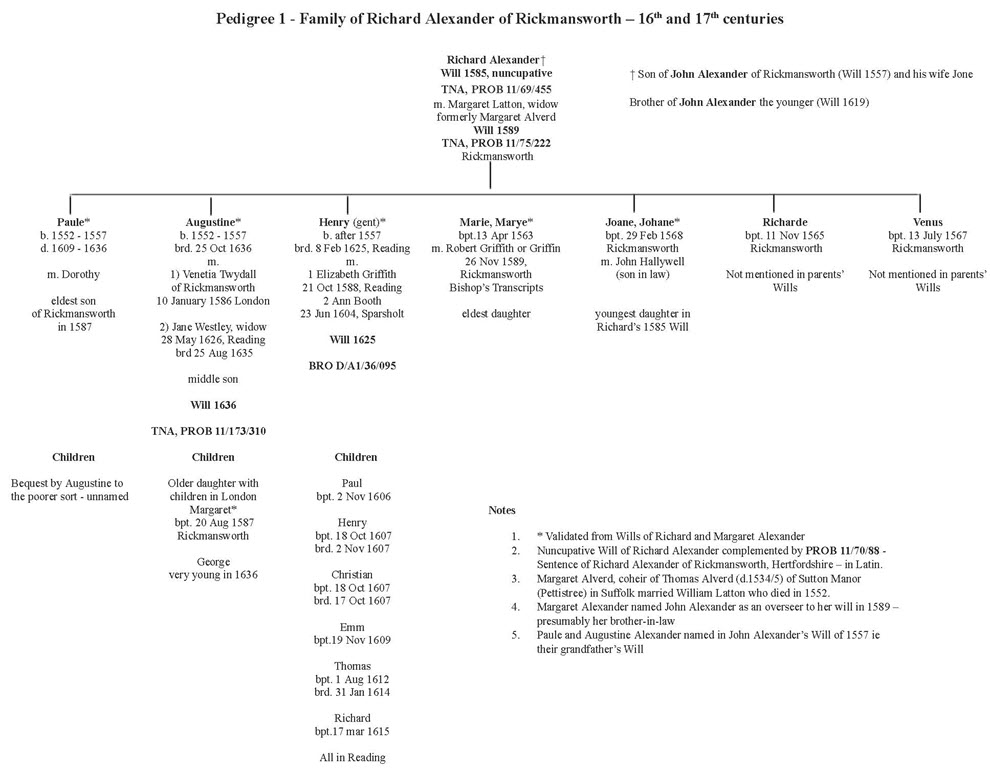
Richard Alexander of Rickmansworth made his nuncupative will on 10 April 158517. A conditional bequest to his wife is, perhaps, indicative of some potential issues which may have preceded the sexpartite agreement of 1587 since it reads:
“he gave and bequeathed unto Margaret Alexander his wyffe one hundred poundes of lawful money of England to bee paide unto her uppon this condicion that the saide margarett should make and convey unto Paule Alexander and Augustine Alexander her sonnes or their assigns one goode sure and pfecte lease or demise in the lawe of all these her manors landes tenements and heriditerments whatsoever within the countie of Suffolk which bee her owne lands by inheritance for and during the tearme of threescore years if the saide margaret should live soe longe: And that they the saide Paule and Augustine and their assignes should quietly and peaceably enjoy the same lease or demyse during all the saide tearme withoute interruption or contradiction of the said margarett or any other person or persons claymynge bye from or under her or by her meanes assent or procurement…….”
The will is informative in terms of family relationships since we learn that Richard Alexander wished to be buried in Rickmansworth near to his father and that he had a sister Joane who was married to Richard Nedeham of Wynsor. His youngest son, Henry was to receive an annuity in the county of Berkshire and two daughters are named as Marye and Joane whose bequests were to be fulfilled on the day of their marriage.
Margaret Alexander made her will in 158918 in which further family details are revealed. She refers to her son-in-law John Hallywell who, by inference, was married to daughter Joane and was in debt to Margaret. His debt was to be recovered and distributed between Joane Alexander and her married daughter Mary Cassey. Daughter Mary was married to Robert Griffith or Griffin who together with Augustine Alexander was made an executor of Margaret’s will. The identity of Augustine’s daughter is revealed as Margaret. The will describes a detailed list of household goods and effects together with some livestock which was equitably bequeathed among this small group of beneficiaries.
The foregoing wills and references allow a family pedigree 1 (on page …) to be constructed which is complemented by entries in the parish registers of Rickmansworth, Reading and London. This forms the basis from which a deeper ancestry is considered.
As overseers to her will Margaret Alexander appointed her cousin Boosto (a nickname perhaps) and John Alexander. His identity is reviewed and clarified following the discovery of two wills in the Hertfordshire Archives for the years 1557 and 1620.
John Alexander of Rickmansworth
On 1 September 1557 John Alexander the elder of Rickmansworth made his will19 in which he revealed that he wished to be buried in the parish church close to where his wife, Jone, lay buried. Bequests to the church itself and the poor in the community reflect a pious man of conscience who wished to make amends for his “negligently
forgotten tithes” but also, with his wife, wished to be remembered in a commemoration service that his executors were to arrange over 12 years following his death. The financial contribution to the service was to be raised from money earned from woodland jointly owned with John’s son Richard. However, apart from this reference the will is striking in the complete lack of bequests of specified lands or real estate.
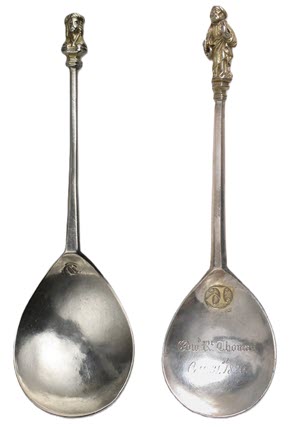
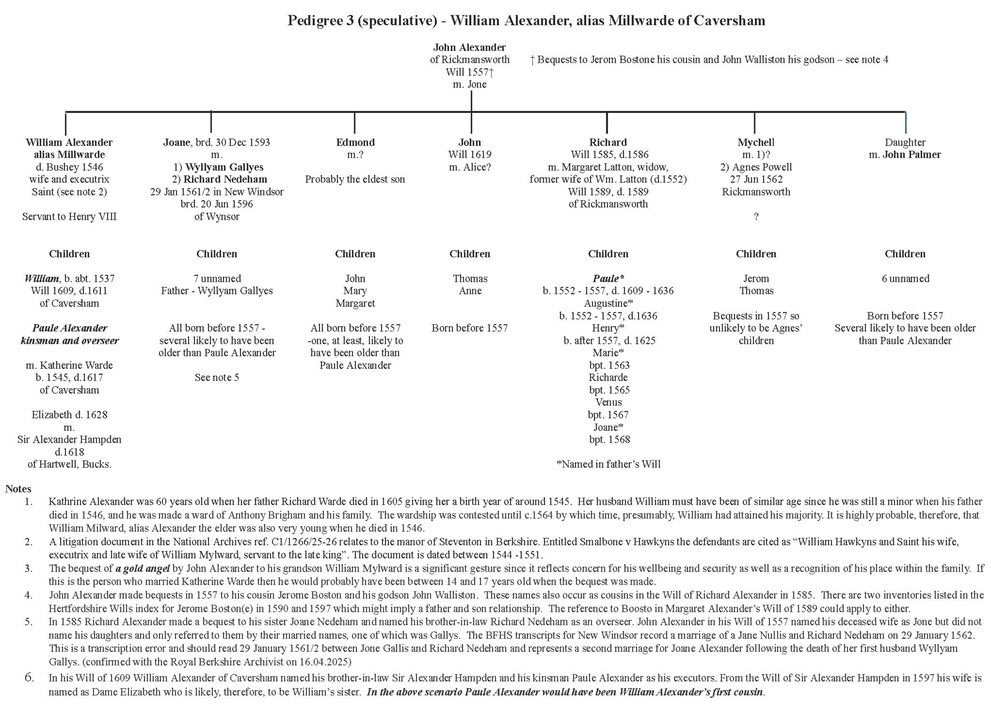
The will sets out John Alexander’s family in detail and is summarised in pedigree 2 .Sons Edmond and Richard were made joint executors, but his daughters were only referred to by their married names. Two other sons were named as John and Mychell and where the families were relatively large, grandchildren were not named. Bequests were mainly, but not exclusively, of gold and silver items, many of which seem to be of symbolic significance. Typical bequests to grandchildren included maidenhead, ship and knopped silver spoons as well as spoons with images of the Apostles.
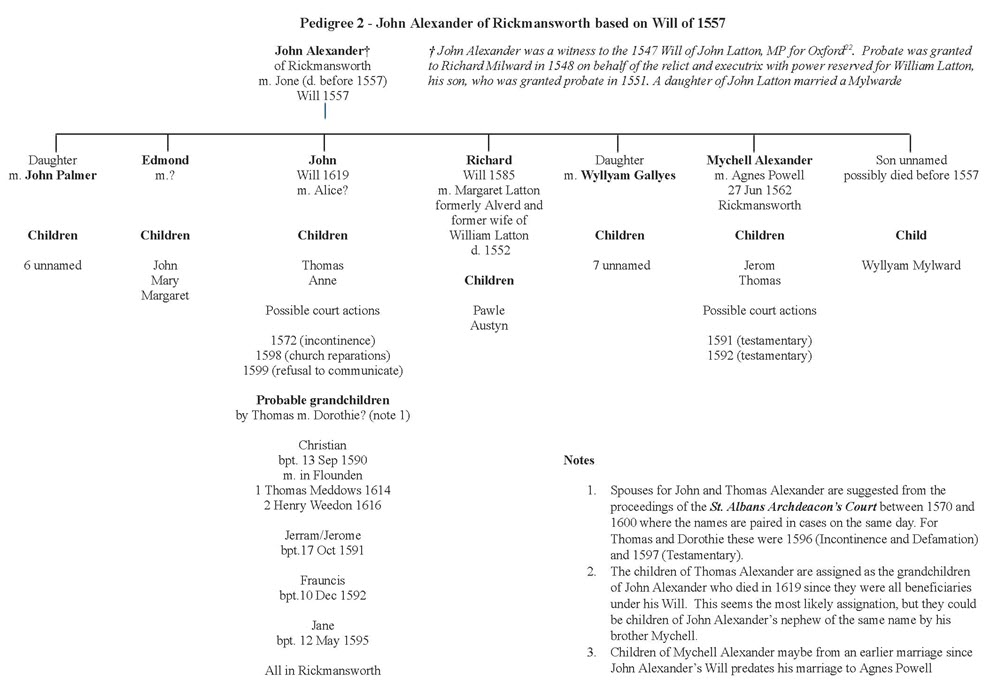
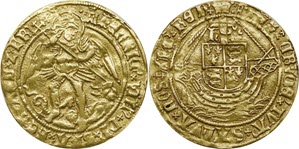 In the context of this article Richard Alexander’s children were named as Pawlle and Austyne but of more telling significance is a bequest of one gold angel to Wyllyam Mylward who was simply referred to by John Alexander as his son’s son and we are left to speculate on who the father may have been. The bequest of this gold coin, however, would have been a meaningful and symbolic gesture which reflected concern for the child’s wellbeing and security and, if the child was a ward, acceptance within the family.
The revelation raises the possibility that Wyllyam Mylward was the person who married Katherine Warde, in which case his father would have been William Millward, alias Alexander, who was granted the Bushey Hall Estate by Henry VIII. When William died in 1546, he must have been very young since his son was made a ward of Anthony Brigham and probably did not attain his majority until latest 1564 after which the wardship was no longer contested. Thus, we can estimate that William the younger was born around 1540 and from the Fine Role of 1609/10 we know that Katherine Warde would have been born in about 1545. The death of William Latton in 1552 and the will of John Alexander of 1557 provide the timeframe for the birth of Paul Alexander. We, therefore, have a window of some 14 years to explore the feasibility that William Millward, alias Alexander, the elder, was indeed the son of John Alexander who died in 1557. This is examined in pedigree 3 of the series which assumes the hypothesis but is, of course, speculative. However, in 1557 one of John Alexander’s daughters had 7 children which would make the eldest of them relatively close in age to William Alexander, alias Milward. In the absence of any conflicting evidence the pedigree is, therefore, credible. In this scenario Paul Alexander who was appointed an overseer to the will of William Alexander in 1609 would have been his first cousin.
An interesting litigation document20 in the National Archives relates to the manor of Steventon in Berkshire in which the defendants in the case are cited as “William Hawkyns and Saint his wife, executrix and late wife of William Mylward, servant to the late king”. The document is dated between 1544 -1551 and fits well within the scenario.
John Alexander’s son John also made a will in 161921 in which he appointed Edmond Alexander as his executor. The will does not specify family relationships, so these must be derived from the combination of names and information in the parish registers. The names help to refine the pedigree but do not add materially to it although bequests to the Garrett family reinforce the links to the Latton family since William Latton’s sister Susan married into it.
Conclusions
The study has not provided clear evidence that the Alexander, alias Milward, families of Caversham and Bicester are linked. However, the dates, names, locations and name transitions all suggest a strong association. The discovery that William Alexander’s sister lived just a few miles from Bicester in her later years establishes a presence in the area which may be relevant.
The research has enabled more detail surrounding the wider relationships and estates associated with the Caversham and Rickmansworth families to be established. The pedigrees which have been proposed are offered to promote further discussion and amendment as new information comes to light. It is clear from the array of documents available at the National Archives, the St. Albans Archdeacon’s Court and other County Archives that the scope for further research is considerable.
Acknowledgement
My thanks to Dr Gillian Clark of Caversham Court for her help and encouragement in writing this article.
References
1 A History of the County of Oxford: Volume 6. The market town of Bicester, VCH, 1959
2 Oxfordshire Wills Index, 1516 -1857 at Findmypast
3 Revised Timeline, Caversham Court Feb 25, 2025, Royal Berkshire Archives
4 https://home.fccg.org.uk/history
5 Fine Roll 7 James 1, part 2, No.30, Chronicles of Finchampstead in the County of Berkshire
6 A History of the County of Hertford: Volume 2. Parishes: Bushey, VCH, London 1908
7 Dictionary of National Biography, 1885.1900, Vol. 6, Brigham, Nicholas by H.R.Brodie
8 Revised Timeline, Caversham Court for years 1546 and 1558 – Royal Berkshire Archives
9 TNA reference PROB 11/119/294
10 TNA reference PROB 11/130/545
11 TNA reference PROB 11/131/424
12 Oxfordshire Wills Index -Will, Inventory, 198.75; 31/2/16
13 Buckinghamshire Archives D-BAS/39/596, Deed Poll, 20 May 1568
14 TNA reference PROB 11/173/310
15 Suffolk Archives – Ipswich HD 1538/329/34
16 https://archive.org/details/manorsofsuffolkn07copiuoft/page/n5/mode/2up
17 TNA reference PROB 11/69/455
18 TNA reference PROB 11/75/222
19 Hertfordshire Archives, Registered Will 6AR111, Filed Will 307AW1, Inventory A25/263
20 TNA reference C1/1266/25-27
21 Hertfordshire Archives, Registered Will 8AR94, Inventory A25/2614
22 Oxfordshire Family History Society Wills Index – John Latton MP for Oxford, Pedigree 2
