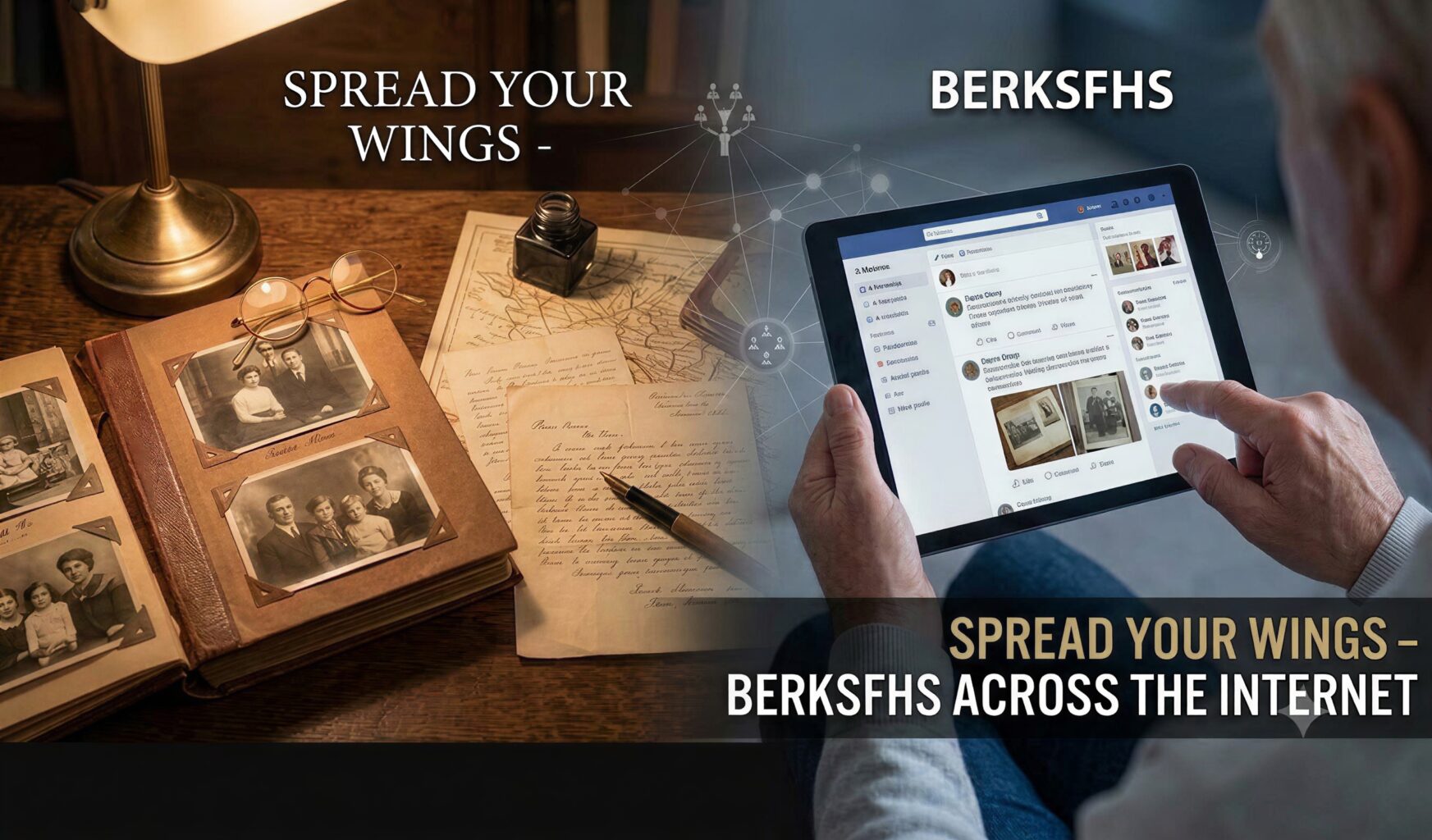
Spread Your Wings – BerksFHS Across the Internet
If you have been following this series, you will by now have a Facebook account, perhaps a growing list of groups you are quietly reading, and a better sense of where to take a research question online. This final article might surprise you.
One of the things that many members do not realise is just how widely Berkshire Family History Society is represented across the internet. Beyond the Facebook Group, the Facebook Page, and the Forum that we introduced in Article 2, our website footer lists a further range of platforms where you can find us. This article takes you through each one – what it is, who tends to use it, and whether it is worth your time.
X – @BerkshireFHS
We touched on X (formerly Twitter) in the first article, but it is worth a fuller mention here. Our X account is particularly useful for event announcements, and following us there connects you indirectly to the wider network of Berkshire cultural and heritage organisations who share each other’s posts. If you are already on X for any reason, we are there. If you are not, the platforms below may suit you better.
Bluesky
Bluesky is the platform that feels most like Twitter did in its earlier, friendlier days – before it became X. It is chronological, conversational, and considerably less noisy than X has become. If you tried Twitter years ago and found it overwhelming, or if you have grown weary of the atmosphere on X more recently, Bluesky is worth a look.
The genealogy community on Bluesky is still relatively small but growing steadily, and the general tone is noticeably civil. You can find us there and follow along as the community develops.
Threads
Threads is Meta’s answer to X – built by the same company as Facebook and Instagram, and linked to an Instagram account if you have one, though it can be used without. It sits somewhere between Facebook and X in character: more conversational than a Facebook Page, less frenetic than X at its busiest.
The platform is still finding its feet in terms of the genealogy community, but it is growing, and having a presence there means we reach people who have drifted away from X but are not ready to commit to somewhere entirely new.
Pinterest tends to get overlooked in conversations about social media, but it has a quietly devoted following among genealogists and it is worth understanding why. Unlike the platforms above, Pinterest is not really about conversation – it is about saving and organising visual content. Think of it as a vast, searchable pinboard.
For family historians, this turns out to be surprisingly useful. People share images of old maps, historical photographs, examples of particular record types, guides to reading old handwriting, infographics about research methodology, and countless other visual resources. You can save anything you find useful to your own boards and return to it later – a kind of visual research notebook.
Pinterest also has a notably broad age range of users, and the atmosphere is unhurried and entirely non-confrontational. If social media has felt like a noisy room you are not sure you want to enter, Pinterest is more like a library with good pictures.
Blogger
Our Blogger presence is rather different in character from the social platforms listed above. Blogger is Google’s long-established blogging platform, and what you will find there is longer-form content – articles, research notes, and pieces that benefit from more space than a social media post allows.
It is not social in the interactive sense – there is no feed to scroll, no algorithm deciding what you see – but it is a useful archive of content, and it is indexed by Google, which means articles posted there can be found by anyone searching for relevant topics. Think of it as our extended reading room.
Google Business Profile
You may not have heard of Google Business Profile, but you have almost certainly encountered it. When you search for an organisation on Google and a panel appears on the right-hand side of the results showing the opening hours, address, contact details, and reviews, that is a Google Business Profile.
Ours means that when someone searches for “Berkshire Family History Society” – or simply “family history Berkshire” – they find accurate, up-to-date information about us immediately, without having to dig through search results. It is less a social platform than a signpost, but it matters because it is often the first thing a potential new member sees. It will feature events that are hosted at the Family Research Centre in Reading.
Wherever you find us – follow us
The practical upshot of all this is simple: wherever you already spend time online, there is a good chance we are there too. You do not need to join every platform – choose the ones that suit you, find us there, and follow along.
Each platform attracts a slightly different audience and carries slightly different content, so following us in more than one place is not repetitive – you will find things on Pinterest that do not appear on X, and vice versa. But even following us in just one place keeps you connected to the society between magazines and events, and that connection matters.
The bonus is that following us will give you access to the network of people, groups and organisations that also follow us and will create a spider’s web of connections to family history related topics, delivered into your feed without you having to lift a finger.
The bigger picture
The internet can feel like an overwhelming place, and the warnings about it are not entirely without foundation. But for family historians in particular, it represents something remarkable: a global community of people who share your curiosity, your passion for the past, and your willingness to spend an afternoon trying to decipher a two-hundred-year-old burial register.
BerksFHS is part of that community, and we are working hard to be present wherever our members – and future members – choose to spend their time online. We hope this series has made the prospect of joining us there feel a little less daunting, and a great deal more inviting.
We will see you online.
This article concludes the five-part series “Connecting with the Past.” We hope you have found it useful. If you would like to share your experience of joining an online family history community, we would love to hear from you – post in the Berkshire Genealogy Facebook Group.
