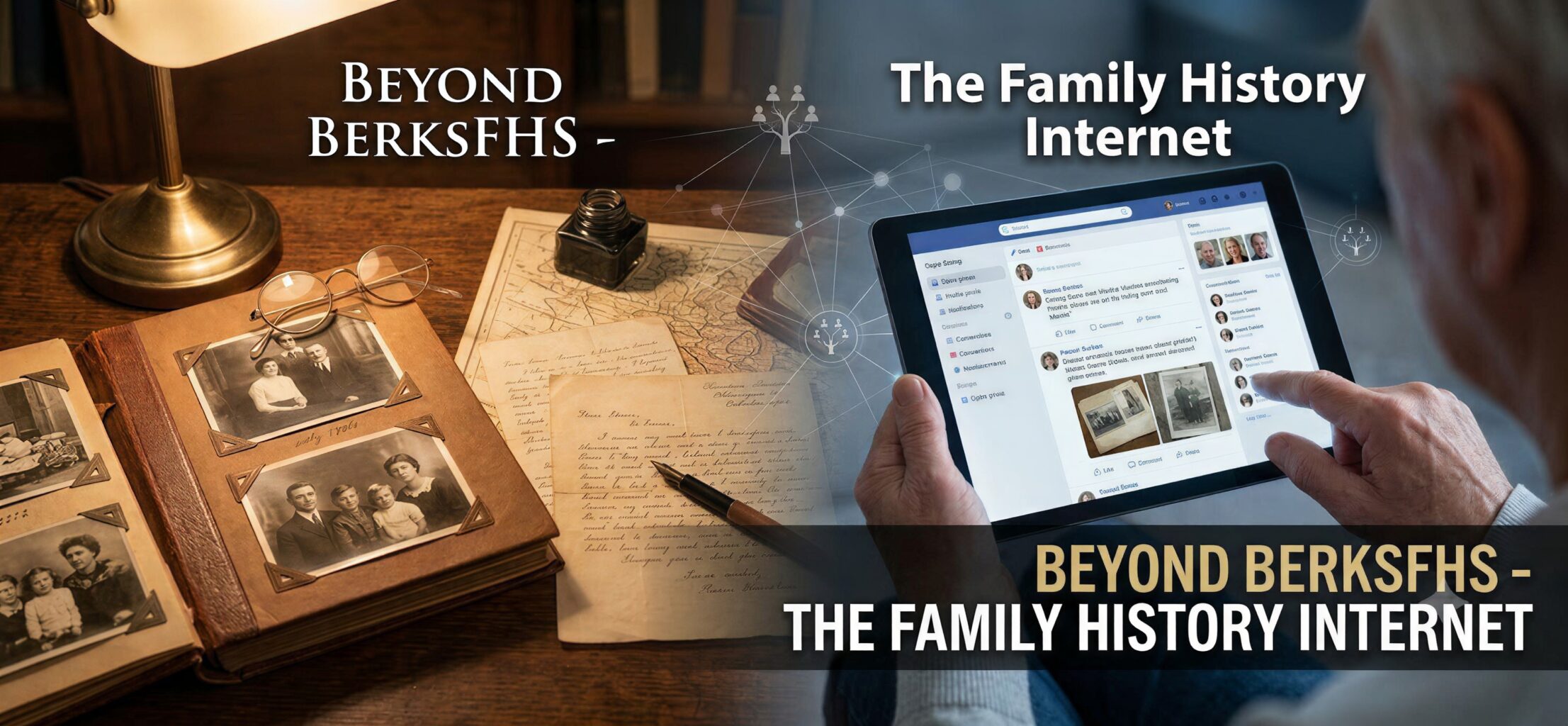
Beyond BerksFHS – The Family History Internet
So far in this series we have talked about safety, privacy, and our own BerksFHS channels. This time, we want to open a much bigger door.
The internet – and social media in particular – has transformed family history research over the past decade. The days when progress meant a long drive to a county record office, followed by hours squinting at microfilm, are not entirely gone, but they have been supplemented by something extraordinary: a global community of researchers, specialists, and enthusiasts who are often willing to help complete strangers unravel their family mysteries.
What follows is a tour of some of the best places to explore – all of it available from your armchair.
Facebook groups for family historians
Facebook hosts thousands of groups dedicated to genealogy, and the quality of many of them is remarkably high. Here are some categories worth exploring:
County and local history groups
There are active groups dedicated to Berkshire history, Berkshire ancestors, and specific towns and villages within the county. These are invaluable if you are trying to understand the world your ancestors lived in – local knowledge that simply cannot be found in any national database. Search Facebook for “Berkshire ancestors” or “Berkshire local history” and you will find several options.
Beyond Berkshire, every county has its equivalent. If your research takes you to Wiltshire, Somerset, or anywhere else, there will be a group for it.
Occupational history groups
If your ancestors worked in a particular industry, there are groups dedicated to exactly that. Railway workers, agricultural labourers, servants in country houses, watermen on the Thames, coal miners, lacemakers – specialist groups exist for all of these and many more. Members often have access to records, knowledge, and contacts that go far beyond what any general genealogy database offers.
DNA and genetic genealogy
If you have taken a DNA test with Ancestry or another provider, you may have found the results simultaneously fascinating and bewildering. Genetic genealogy has its own vocabulary and its own logic, and it can take time to understand what your matches actually mean.
Facebook groups dedicated to genetic genealogy are enormously helpful here. There are general groups for DNA beginners, groups specific to each testing company, and specialist groups for techniques like chromosome mapping and identifying unknown parentage. Members range from absolute beginners to highly experienced researchers who volunteer their time to help others work through their results.
A good starting point is searching Facebook for “genetic genealogy” – you will find several large, active, and welcoming groups. Tip: Debbie Kennett, one of the volunteers that facilitates our Facebook Group, is a DNA expert and author. Debbie also runs our quarterly DNA Special Interest Group – an online meeting/workshop where you can get your questions answered. Check our What’s On listing on the website or look out for our newsletters. We will also post details of the next event on our Facebook Page.
Photo identification and restoration
This is one of the genuine delights of online family history communities. Groups dedicated to old photograph identification – working out when a photo was taken from the clothing, hairstyles, and photographic format – can help you date an undated portrait with surprising accuracy. Members include professional photographers, costume historians, and enthusiastic amateurs with decades of experience.
More recently, groups focused on AI-assisted photo restoration have emerged. Free and low-cost tools now exist that can restore damaged photographs, repair tears and foxing, and even add colour to black-and-white images with impressive results. If you have a box of old family photographs in poor condition, these communities can show you what is possible.
Search Facebook for “photo detective genealogy” or “genealogy photo restoration” to find active groups in this area.
One-name and one-place studies
If you are pursuing a particular surname or a specific parish in depth, one-name and one-place study groups can connect you with other researchers who are working on exactly the same ground. These are often small but highly specialist communities where extraordinary progress can be made.
The Guild of One-Name Studies (GoONS) has its own Facebook presence and can point you toward registered studies for thousands of surnames.
YouTube – the family historian’s classroom
YouTube is not social media in the interactive sense, but it deserves a mention here because it has become one of the most valuable educational resources available to family historians.
Tutorials exist for almost every aspect of genealogy research – how to use Ancestry, FindMyPast, and the Genealogist; how to interpret census records, wills, and parish registers; how to understand DNA results; how to restore old photographs; how to research specific occupations, regions, or time periods. Many of these tutorials are made by experienced researchers who are genuinely expert in their subject.
The great advantage of YouTube is that it is entirely passive. You watch, you learn, you pause and rewind as needed, and you share nothing about yourself at all. It is also free. Search for “genealogy tutorial” combined with whatever you are trying to learn, and you will almost certainly find something useful.
Channels worth exploring include those run by the major genealogy platforms themselves (Ancestry, FindMyPast, MyHeritage all have official channels), as well as independent researchers and the larger family history societies.
A note on quality
Not everything online is reliable – this is as true of genealogy as of anything else. Groups and channels vary in quality, and it is always worth applying the same critical thinking to online information that you would bring to any other source. A helpful rule of thumb: treat an online suggestion as a pointer toward a primary source, not as a primary source in itself. If someone in a Facebook group tells you your great-grandmother was born in a particular parish, treat it as a lead to follow up, not a fact to record in your family tree. The ABC golden rule for family historians is very relevant – Accept nothing, Believe no one, Check everything.
With that caveat, the overall quality of family history communities online is high. People who give up their time to help strangers with research tend to take it seriously.
Where to start
If this article has piqued your interest but you are not sure where to begin, here is a simple suggestion: think of one research problem you are currently stuck on, and search Facebook for a group that might be able to help. It might be a county, an occupation, a DNA puzzle, or an unidentified photograph. Join it, have a look around, and get a feel for the kinds of discussions that take place there.
Whether you post something straight away or read quietly for a few weeks first is entirely up to you. Either way, you have made a start.
Next issue: Once you are in – getting the best from online communities.
