
An unusual and hitherto neglected travel journal has been hidden in plain sight among British Library manuscripts, since it was bought at auction in 1984 (British Library, Harriet Parry, journals: ADD MS 62945 A & B). It was a chance find in the catalogue several years ago while searching for a different item, which I decided to follow up more recently and which has demonstrated not only the complexities of uncovering the lives of ordinary people but also how rewarding this can be.
The journal writer, Harriet Parry (1785-1851), lived most of her life in the rural village of Speen near Newbury, and for a while in Clifton, Bristol. Her father and grandfather were vicars of Speen parish church. The first archive I consulted was the collection of parish records held at the Royal Berkshire Archives in Reading, from which a background picture of Harriet’s life and details about her family and the village began to emerge. The entries of births, marriages and deaths revealed patterns in the lives of local families and institutions, comparable with the national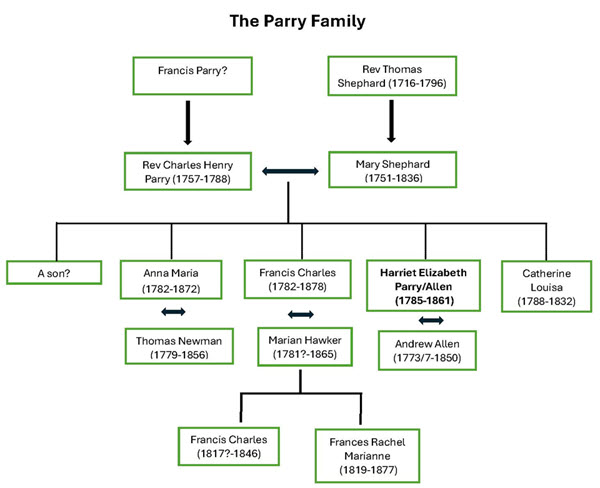 picture of rural life at that time. In addition, The National Archives probate and will records were obvious sources to access and to establish important dates and family connections. Bristol Archives held details about St. Andrew’s Church where Harriet worshipped, although much was lost when it was destroyed during World War II. The Hon. Society of the Middle Temple Archive have logs about Harriet’s barrister brother who was admitted in 1803 and later became Commissioner of Bankrupts and Deputy Registrar of the Bankruptcy Court from 1810 to 1832. This brother published a book on charitable donations in Berkshire which made him a more visible member of the family for research. Genealogy resource websites online allowed a bigger picture to emerge about family networks, but are not a substitute for archival visits.
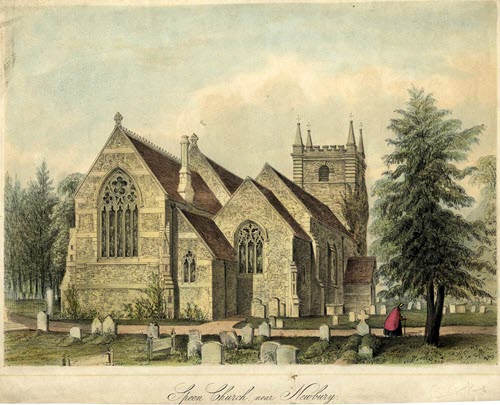
The parish registers reveal much about life in rural Berkshire, while the Napoleonic wars were inflicting so much hardship on the population. Militia were stationed in the area, and soldiers from the East Suffolk Regiment and the 15th Regiment of Light Dragoons married in the church and were buried in the churchyard, along with inmates of the two workhouses. Foundlings sent from London to nurse and the children of itinerant Irish labourers were baptised and buried there. Harriet’s older brother appears to have died in 1793, a year of many child burials. Her father also died young, and her grandfather took on the role of vicar again, partly to enable her mother to stay on in the vicarage. Later in life Harriet married a widower with American family connections whose objection to Independence determined a subsequent move to England. This may be a fascinating thread to take up in the future! While living in Bristol, Harriet’s husband died, and she and her sister returned to Speen where they are now commemorated on a brass plaque in the church for their charitable works.
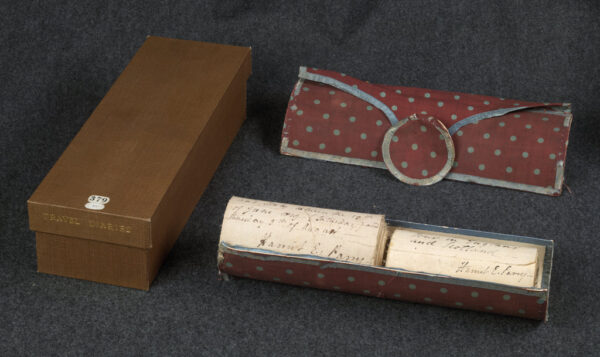
In 1819, at the age of thirty-four, Harriet undertook a tour to France, Switzerland and northern Italy at a time when travellers were flocking to the Continent after Waterloo and the defeat of Napoleon made travel possible again. Harriet’s absence in modern scholarship on travel literature may be explained by the unusual nature of her journal. There are many published travel accounts from this time but Harriet’s narrative, though not great literature, is unique. It was never published, and its format would make it difficult to do so. The journal was written on a three-metre-long home-made scroll of linen-backed paper and carefully stored in a hand-sewn fabric-covered box, alongside a scroll made later during a tour to Scotland. These were thoughtfully prepared before she embarked on her trips and bear witness to Harriet’s thrift and her needlework skills. The linen was cut from a previous sewing project as there are remaining loose threads from unpicked seams across parts of the linen backing. Since the female members of a vicar’s family would be expected to provide linen both for the family and for poor parishioners, Harriet’s scrolls may represent this everyday reality of her life at home before she undertook her new adventure.
My work attempts to read between the lines of Harriet’s account to uncover some idea of her as a person, her interests and attitudes, which bare historical data cannot provide. We know nothing about her education but the evidence from her first travel account points to a conservative Anglican upbringing with a focus on music, history, languages and literature and occasional visits to the theatre and to popular spa towns (Tunbridge Wells and Malvern). She was also very knowledgeable about the tree and plant species she observed along the way. Her journal was constructed in the manner of an account book, with ruled lines to record dates, regions, towns and the distances travelled. She included small sketches in pale watercolour wash, outlined in black. They are a carefully drawn and delightful element of her diary, but interestingly she did not add any people to her views of monuments and mountains. Her account is a simple record of the journey which includes brief and sometimes cryptic personal observations, but there is no hint of who accompanied her and she surely did not travel alone.
Harriet visited the galleries, theatres and sights of Paris, noting the many reminders of Napoleon’s recent rule. It is clear that she, like many European travellers at this time, was fascinated by the emperor. Her comments reflect an ambivalence in her opinions but also her susceptibility to romanticising his legacy. This contrasts with her less enthusiastic report on the restored Bourbon royal family, seen on their way to the Royal Chapel in the Tuileries, ‘Louis 18, of immense size, & supporting himself with 2 sticks’ (27th June). She was impressed with the Empress Marie Louisa’s silk furnishings and plate glass bath at the Chateau of Compiegne but disappointed at Fontainebleau where ‘In an anti room [sic] to the State room is a common little round mahogany table on which Bonaparte signed his abdication’ (29th June). Occasionally Harriet could not resist criticising the locals, especially when their religious practices offended her Protestant sensibilities. She attended a church service in the village of Simplon where the ‘mass and sermon [are] in German: an organ & all ye people singing to it in the highest key possible – screaming (11th July)’. She was unforgiving in her assessment of the opera at La Scala in Milan, ‘An immense house – 6 tier high – the opera Henry 8th – no music & poor acting – Anne Bullen a miserable little thing – & Cath of Aragon a fat vulgar woman. A curious illuminated clock over the stage (the hands illuminated). (14th July)’.
However, we find Harriet at her best when her journey across the Alps demanded courage and fortitude. Her nine-hour expedition on the Glacier Montanvert across the Mer de Glace involved ‘several avalanches on return’ and later a hazardous ‘path for a mule & hardly wide enough for that with the mountain on one side & a precipice on ye other’ (9th July). She had already mentioned the ‘cross erected to mark the spot
where a traveller who fell down a precipice was preserved from harm’ (7th July). She empathised with that traveller’s lucky escape. One senses her delight at her own bravery and anticipation of retelling her adventure later on her return.
Uncovering Harriet’s life and studying her journal has resulted in the publication of two chapters, the first a close analysis of the materiality and construction of the journal itself; the second a discussion of her summer trip, its route and the unique voice we can identify in Harriet’s narrative.
The Cultural Construction of Hidden Spaces: Essays on Pockets, Pouches and Secret , Drawers, eds. James Brown, Anna Jamieson, and Naomi Segal (Leiden: Brill, 2024) https://brill.com/display/book/9789004694729/BP000003.xml
Travellers in Eighteenth Century Europe: The Sexes Abroad, ed. Julie Peakman (Pen & Sword, 2025) https://www.pen-and-sword.co.uk/Travellers-in-Eighteenth-Century-Europe-Hardback/p/50781
